 Roy's AI Lab
Evaluate the Judge, Too: Can You Trust an AI Grader?
How to test a model-based grader for bias, blind spots and hidden mistakes
31 October 2026 · Ritesh Rai
Quick answer
- An AI grader is a measuring tool, so it needs its own validation before you rely on it.
- Write a clear rubric with separate criteria, instead of one vague overall score.
- Test for known biases, such as favouring the first answer or the longer answer, and compare the grader with carefully reviewed examples.
You've built an AI assistant, and now you have thousands of answers to check. Reading them all yourself would take weeks. So you ask a language model to grade them: "Rate this answer from 1 to 10."
It works well on the first few examples. The scores look sensible. You're tempted to trust it for the rest.
Stop there. A grader is a measuring instrument, and a measuring instrument needs checking before you use it. If your judge is wrong in a consistent way, every decision built on its scores will be wrong too, and it will look perfectly confident while doing it.
Why read this? Because automated grading is now common in AI teams, and "we used an LLM to judge it" is a claim that deserves hard questions. It's also a sharp interview topic.
What an LLM judge does
An LLM judge reads an output and assesses it. It uses instructions, criteria and sometimes reference evidence, such as the correct policy text.
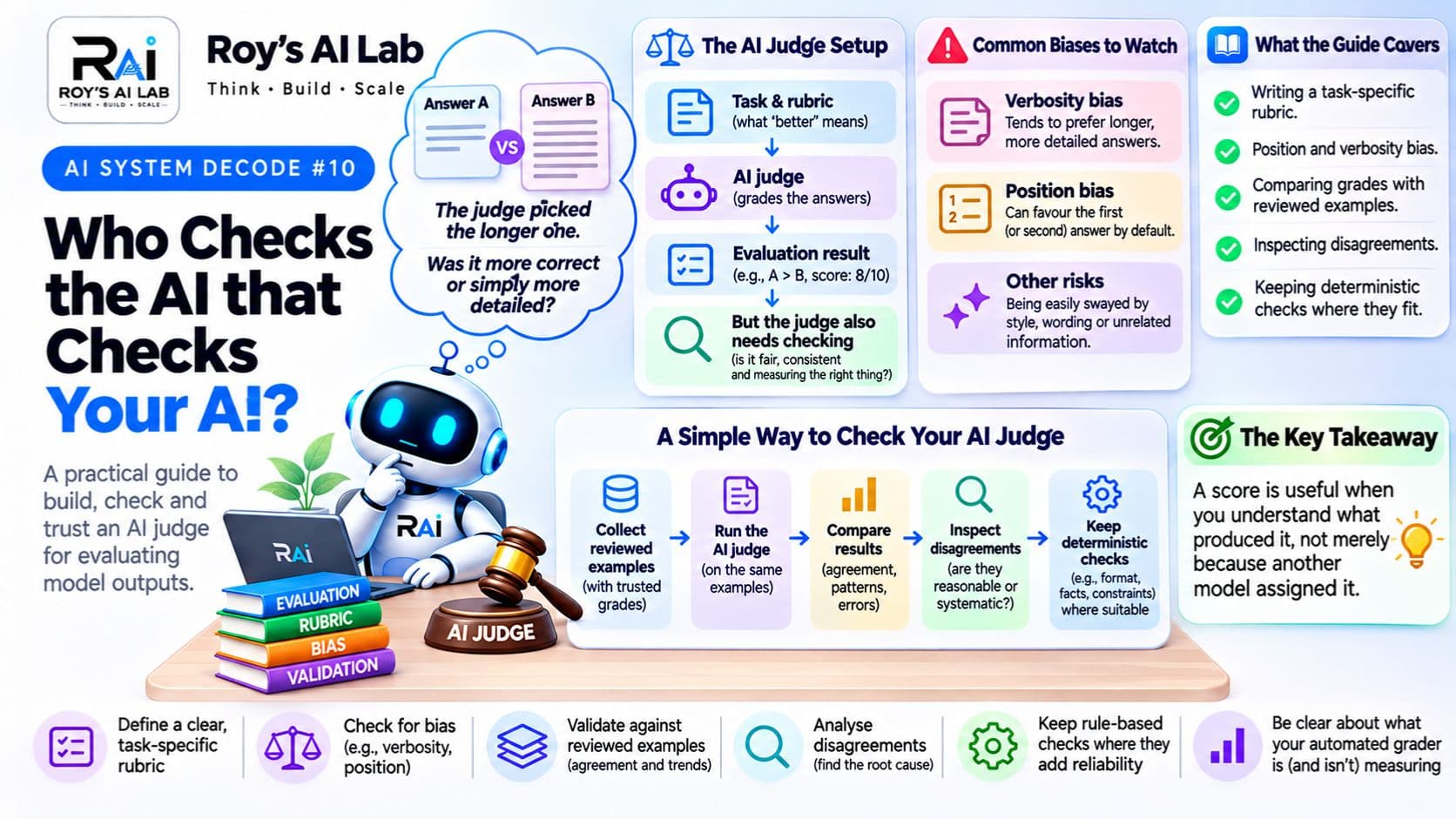
It can support evaluation at a scale humans can't match. But its scores aren't automatically reliable measurements. OpenAI's evaluation guidance names specific challenges, including position bias, where the order of answers affects the grade, and verbosity bias, where longer answers tend to score higher.
Five things to understand
Define the task. "Rate this answer" is too vague. Spell out the behaviours that matter. What does a good answer do, and what does a bad one get wrong?
Separate the dimensions. Correctness, support from the evidence, scope and writing quality are different things. An answer can be well written and still wrong. Grade them separately.
Supply the relevant evidence. A grader checking whether a policy answer is correct needs the policy, not only the answer. Without it, the judge is guessing.
Test the grader. Compare its decisions with carefully reviewed examples. Human reference judgements can also be ambiguous, so write down the rubric they were based on.
Investigate disagreements. When the judge and a human disagree, the cause could be a grader problem, an unclear criterion, or a wrong reference label. Don't treat every mismatch as the same failure.
Follow the evaluation
Task + source evidence + rubric
                ↓
         Model-based judge
                ↓
      Grade + supporting rationale
                ↓
   Compare with reviewed examples
                ↓
 Investigate and refine the process
A rationale helps you inspect the judge's reasoning. But a fluent explanation doesn't prove the grade is correct. Treat it as a clue to check, not as evidence.
A worked example
Here's the evidence the assistant was given:
"Standard subscriptions: cancellation within 14 days."
Two answers come back from the assistant.
Answer A: "Standard subscriptions can be cancelled within 14 days."
Answer B: "All subscriptions can be cancelled within 14 days. Our flexible policy makes cancellation convenient."
Answer B is longer. Before reading on, which one should the judge score higher?
The answer: Answer A. Answer B expands the policy beyond what the evidence supports. It says "all subscriptions," when the evidence only covers standard ones, and it adds a claim about convenience that the policy doesn't make. A judge that rewards the extra length has failed the task. A good rubric penalises unsupported expansion.
A small rubric
Check each dimension separately:
- Correct period: does the answer state the right number of days?
- Correct scope: does it apply the rule only to the right subscriptions?
- Unsupported claims: does it add anything the evidence doesn't support?
- Clear expression: is it easy to understand?
For each one, write a pass or fail example, or a clear scoring scale. Avoid a single overall score, because it can hide an important failure. An answer with a wrong period and a lovely tone might still average out to a decent score.
Probe the known biases
For pairwise grading, where the judge compares two answers, test for bias on purpose:
- Swap the order. Does the verdict change when the same two answers appear in the other order? If it does, position is influencing the grade.
- Compare concise and verbose versions. Does the judge prefer the longer one even when the extra words add nothing?
- Include polished but unsupported answers. Does a confident, well-written answer beat a plain, correct one?
- Include awkward but correct answers. Does a correct answer get marked down for its phrasing?
Inspect whether the grades still reflect the criteria you care about. Swapping order is a useful diagnostic, but passing it doesn't mean the judge is unbiased.
Pause and think: is an LLM the right tool for every check?
Imagine you ask the judge to check whether a response is valid JSON with a required field present.
Should you?
Pause before reading on.
The answer: no. Use code for checks it can verify directly, such as required fields, allowed values or valid formats. Use a model, or a human, where the check needs judgement about meaning. Asking an LLM to replace every deterministic check adds cost and new failure modes for no benefit.
The test: does it agree with people?
Here's a tempting conclusion: "The judge agrees with human reviewers on the easy examples, so it's ready."
Is it?
The answer: not yet. Easy examples are the least informative test. Check difficult, ambiguous and representative cases. Then keep monitoring production, because new kinds of failure will appear that your test set never covered.
An interview follow-up
"How would you know an LLM grader is trustworthy?"
A strong answer covers four things:
- A rubric that breaks the task into separate, testable criteria.
- Agreement checks against carefully reviewed human examples, including difficult ones.
- Tests for known biases, such as answer order and length.
- Ongoing monitoring, with a plan to investigate disagreements rather than ignore them.
Then add the limits. An automated judge can be useful for scale, but it isn't proof that the system is safe for consequential decisions.
A quick checklist
Before you trust an LLM grader, ask yourself:
- Is the rubric specific enough that two people would apply it the same way?
- Are the criteria graded separately, rather than blended into one score?
- Does the judge see the evidence it needs?
- Have I tested it against reviewed examples, including difficult ones?
- Have I checked for position and length bias?
- Am I using code for the checks code can handle?
A note on limits
This post is a starting point for validation, not proof that an automated judge is safe for high-stakes decisions. No judge was benchmarked for this post. The policy example is fictional, and the rubric is an illustration you should adapt to your own task.
Keep learning
Want to connect this to the rest of your evaluation thinking?
- How do you evaluate a RAG system? https://roy-s-ai-lab.vercel.app/blog/how-do-you-evaluate-a-rag-system-the-4-metrics-that-actually-matter
- Same scores, different decisions: https://roy-s-ai-lab.vercel.app/blog/same-scores-different-decisions-threshold
- Your test set is not a feedback loop: https://roy-s-ai-lab.vercel.app/blog/your-test-set-is-not-your-feedback-loop
- Free AI agent interview answers: https://roy-s-ai-lab.vercel.app/interview-qa/AI%20Agents
- Full guides and scenario packs: https://roy-s-ai-lab.vercel.app/products
Try this: take one answer you've produced recently. Write three separate pass or fail criteria for it, then check whether a judge would apply them the same way you do.
Source
- OpenAI, "Evaluation best practices": https://developers.openai.com/api/docs/guides/evaluation-best-practices
The source was checked for the position-bias and verbosity-bias challenges, the recommendations on pairwise and pass/fail grading, and the advice to validate against human judgements. The rubric, the worked example and the checklist are original teaching material.
Ritesh Rai
Keep reading
Read these next
- AI ApplicationsPrompt Caching Is Not Answer Caching: What Your AI App Is Really ReusingWhat gets reused, why an exact match matters, and how to prove it actually saves moneyRead
- AI ApplicationsFaster Calls Don't Always Mean a Faster App (Here's How to Tell)Where the time really goes in an AI app, and how to speed it up without hurting qualityRead
- AI ApplicationsDesign the Problem Before You Choose the StackHow to turn a vague request into a clear plan you can defend in an interviewRead