 Roy's AI Lab
Same Scores, Different Decisions: How One Threshold Changes Everything
How one cutoff changes your alerts, your misses and your precision
31 October 2026 · Ritesh Rai
Quick answer
- A threshold turns a model's score into a yes or no decision. Moving it changes the decisions, even though the model stays the same.
- A higher threshold usually means fewer alerts and more misses. A lower threshold usually means more alerts and more false alarms.
- Pick the threshold based on what each kind of mistake costs, and choose it on validation data, not on the final test set.
Your model is finished. It gives every incoming message a score from 0 to 1. Now someone has to decide what counts as "urgent."
That decision is a threshold, and it matters more than most people expect. Change the cutoff, and the same scores produce different alerts, different misses and a different story about how good the model is.
Why read this? Because threshold choice is one of the most common questions in real projects and in interviews, and it's easy to get wrong without noticing.
What a threshold does
A binary classifier often produces a score. A threshold converts that score into a label.
In this example, the rule is simple: predict "urgent" when the score is at or above the threshold. Anything below it is "routine."
One caution: a model score isn't automatically a true probability. A score of 0.8 doesn't necessarily mean an 80% chance of urgency. Don't read scores as probabilities unless the model has been calibrated for that purpose.
Try this first
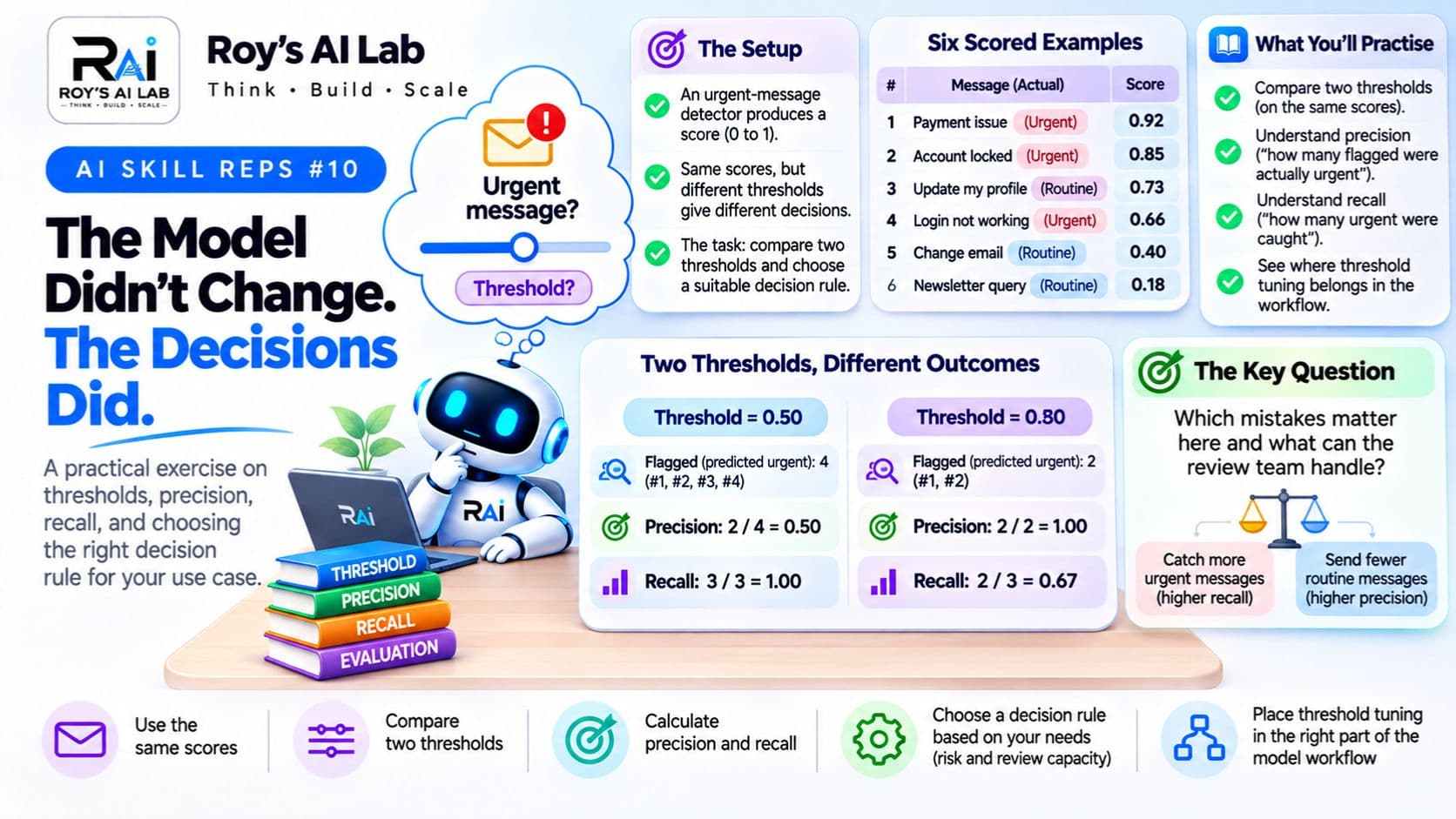
Here are six fictional messages, with the model's score and the true label:
| Message | Score | Actual label |
|---|---|---|
| A | 0.90 | Urgent |
| B | 0.75 | Routine |
| C | 0.60 | Urgent |
| D | 0.45 | Routine |
| E | 0.35 | Urgent |
| F | 0.10 | Routine |
Compare two thresholds: 0.50 and 0.80. For each one, count the true positives, false positives and false negatives. Then work out precision and recall.
Try it on paper before reading on.
Check your thinking
Threshold 0.50. Messages A, B and C are flagged urgent.
- True positives: 2 (A and C were really urgent).
- False positives: 1 (B was routine, but got flagged).
- False negatives: 1 (E was urgent, but missed).
- Precision: 2 out of 3 flagged were urgent, so 2/3.
- Recall: 2 out of 3 urgent messages were caught, so 2/3.
Threshold 0.80. Only message A is flagged.
- True positives: 1.
- False positives: 0.
- False negatives: 2 (C and E were urgent, but missed).
- Precision: 1 out of 1 flagged was urgent, so 1.
- Recall: 1 out of 3 urgent messages was caught, so 1/3.
The higher threshold gives fewer alerts, and every alert it does give is correct. But it misses two of the three urgent messages. The lower threshold catches more urgent messages, at the cost of one false alarm.
Follow the decision
The threshold sits in the middle of a simple chain:
Model score
     ↓
Chosen threshold
     ↓
Predicted label
     ↓
Action or review
Here's the key point. Changing the threshold changes the decision process. It doesn't change the model. You don't need to retrain anything to move the cutoff, which is why threshold choice is often the cheapest lever a team has.
Which threshold is better?
The honest answer: you can't decide from these six numbers.
Ask yourself these questions instead:
- How costly is a missed urgent message?
- How costly is a false alert?
- How many alerts can your reviewers handle in a day?
- Are these examples representative of real traffic?
If a missed urgent message is very costly, a lower threshold may be worth the extra false alarms. If reviewers are overloaded, a higher threshold may be the only realistic option. The table shows the arithmetic. The business decides the trade-off.
Also remember that six messages are far too few to establish a real threshold. This is a demonstration of the calculation, not a production recommendation.
Connect it to the test set post
Should you keep trying thresholds until the test score looks good?
No. The threshold is a development decision, just like choosing a model. Pick it using validation data, or cross-validation, and then check the chosen approach once on held-out test data.
This is the same discipline covered in our post on test sets and feedback loops. If you tune the threshold against the test set, the final number stops being an honest estimate.
Scikit-learn includes a tool for exactly this. Its TunedThresholdClassifierCV tunes the decision threshold using cross-validation, rather than against the test set.
Pause and think
Your team wants more urgent messages caught. Someone suggests retraining the model with more data. Someone else suggests lowering the threshold.
Which one changes the decisions faster, and what might it cost?
Pause before reading on.
The answer: lowering the threshold changes decisions immediately, with no retraining. But it can flood reviewers with false alarms. Retraining may improve the scores themselves, which takes longer and might not help the decision you care about. Both are valid levers. The right choice depends on the goal, the cost and the time you have.
An interview follow-up
"Does lowering the threshold always reduce precision?"
No. This is a common oversimplification.
Lowering the threshold can add true positives, false positives, or both. Recall can't decrease when you lower the threshold on the same scores, because you're only flagging more cases. Precision can go up, down or stay the same, depending on whether the newly flagged cases are mostly correct.
Scikit-learn's precision-recall example makes this point clearly. It notes that lowering a threshold may increase recall, while precision fluctuates, and that once the threshold is already low, adding more cases tends to add false positives and reduce precision.
A strong answer avoids a memorised rule. It walks through what changes, and why.
A quick checklist
Before you choose a threshold, ask yourself:
- Have I written down what a false alarm and a missed case each cost?
- Do I know how many alerts my team can review?
- Am I choosing the threshold on validation data, not the test set?
- Have I checked precision and recall, not just one of them?
- Am I treating the score as a score, not automatically as a probability?
A note on limits
The messages, scores and labels here are fictional, and six examples can't show how a real model behaves. Real thresholds depend on the data, the costs, and how the results will be used.
Keep learning
Want to practise these ideas until they feel natural?
- Your model scored 95%. Better than what? https://roy-s-ai-lab.vercel.app/blog/your-model-scored-95-percent-better-than-what
- Your test set is not a feedback loop: https://roy-s-ai-lab.vercel.app/blog/your-test-set-is-not-your-feedback-loop
- Free machine learning practice sets: https://roy-s-ai-lab.vercel.app/topics/machine-learning. Set 3 covers evaluation and metrics.
- Full guides and scenario packs: https://roy-s-ai-lab.vercel.app/products
Try this: take the table above and change one threshold. Write one sentence explaining who gains and who loses.
Sources
- Scikit-learn, "Precision-Recall": https://scikit-learn.org/stable/auto_examples/model_selection/plot_precision_recall.html
- Scikit-learn, "TunedThresholdClassifierCV": https://scikit-learn.org/stable/modules/generated/sklearn.model_selection.TunedThresholdClassifierCV.html
Both sources were checked. The precision-recall example supports the interview points, and the TunedThresholdClassifierCV page confirms that the threshold is tuned using cross-validation. The messages, scores and calculations are fictional teaching examples.
Ritesh Rai
Keep reading
Read these next
- Machine LearningYour Test Set Is Not a Feedback Loop: How to Keep Model Evaluation HonestWhy choosing models by their test scores quietly ruins your final resultRead
- Machine LearningYour Model Scored 95% Accuracy. Is That Actually Good?Why a high score can hide a useless model, and how to check against a simple baselineRead
- Machine LearningA Good Score Can Hide Data LeakageTwo quick checks that catch hidden mistakes in your evaluationRead