 Roy's AI Lab
Full Catalog
All Products
Premium AI resources designed to help you crack interviews faster.
Premium Products
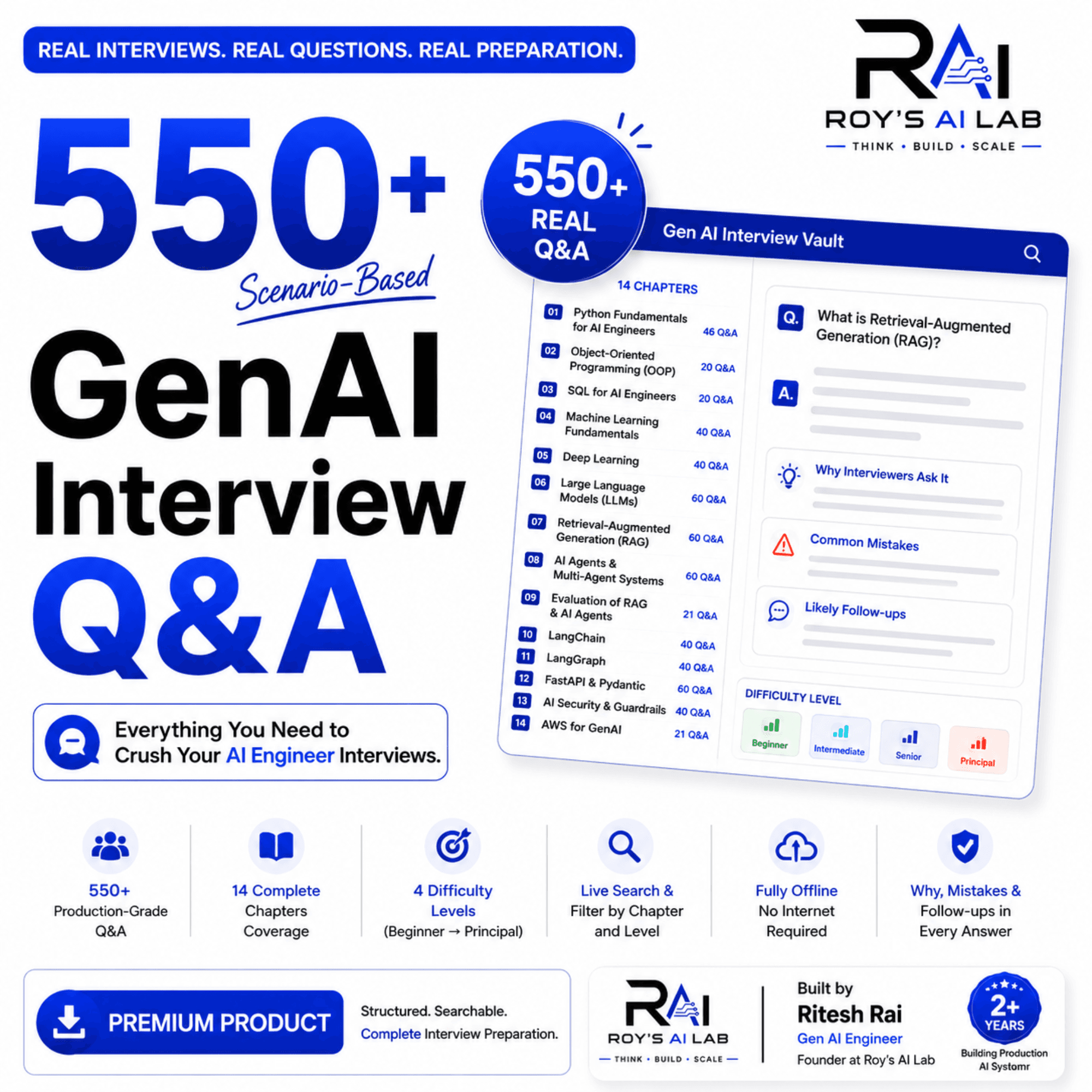
The Ultimate AI Engineer Interview Handbook — 2026 Edition
550+ Real Interview Q&A Across 14 Chapters
🚀 Stop wasting time on random interview prep. This is a structured, searchable Q&A handbook with 550+ real interview questions and answers — everything you need to walk into a Gen AI / AI Engineer interview prepared, not guessing. ✅ 14 CHAPTERS — COMPLETE INTERVIEW COVERAGE: → Chapter 01 — Python Fundamentals for AI Engineers (46 Q&A) → Chapter 02 — Object-Oriented Programming (OOP) (20 Q&A) → Chapter 03 — SQL for AI Engineers (20 Q&A) → Chapter 04 — Machine Learning Fundamentals (40 Q&A) → Chapter 05 — Deep Learning (40 Q&A) → Chapter 06 — Large Language Models (LLMs) (60 Q&A) → Chapter 07 — Retrieval-Augmented Generation (RAG) (60 Q&A) → Chapter 08 — AI Agents & Multi-Agent Systems (60 Q&A) → Chapter 09 — Evaluation of RAG & AI Agents (21 Q&A) → Chapter 10 — LangChain (40 Q&A) → Chapter 11 — LangGraph (40 Q&A) → Chapter 12 — FastAPI & Pydantic (60 Q&A) → Chapter 13 — AI Security & Guardrails (40 Q&A) → Chapter 14 — AWS for GenAI (21 Q&A) ✅ WHAT'S INSIDE: → 550+ production-grade Q&A — not generic textbook definitions → Every answer includes why interviewers ask it, common mistakes, likely follow-ups. → Structured across 4 difficulty levels — Beginner → Intermediate → Senior → Principal → Live search + filter by chapter and level → White-themed, clean design - works in any browser, no login needed → Fully offline - no internet required once downloaded ✅ WHO IS THIS FOR: → Anyone actively interviewing for GenAI / AI Engineer roles → Data analysts and SWEs transitioning into LLM engineering → Freshers targeting AI Engineer roles → Anyone who wants real, structured interview prep — not scattered YouTube notes ✅ HOW IT WORKS: Download the HTML file → Open in any browser (Computer / Tab) → Search or filter by chapter/level → Study Q&A at your own pace, offline, anytime. Built by Ritesh Rai — Gen AI Engineer & Founder at Roy's AI Lab with 2+ years building production AI systems.
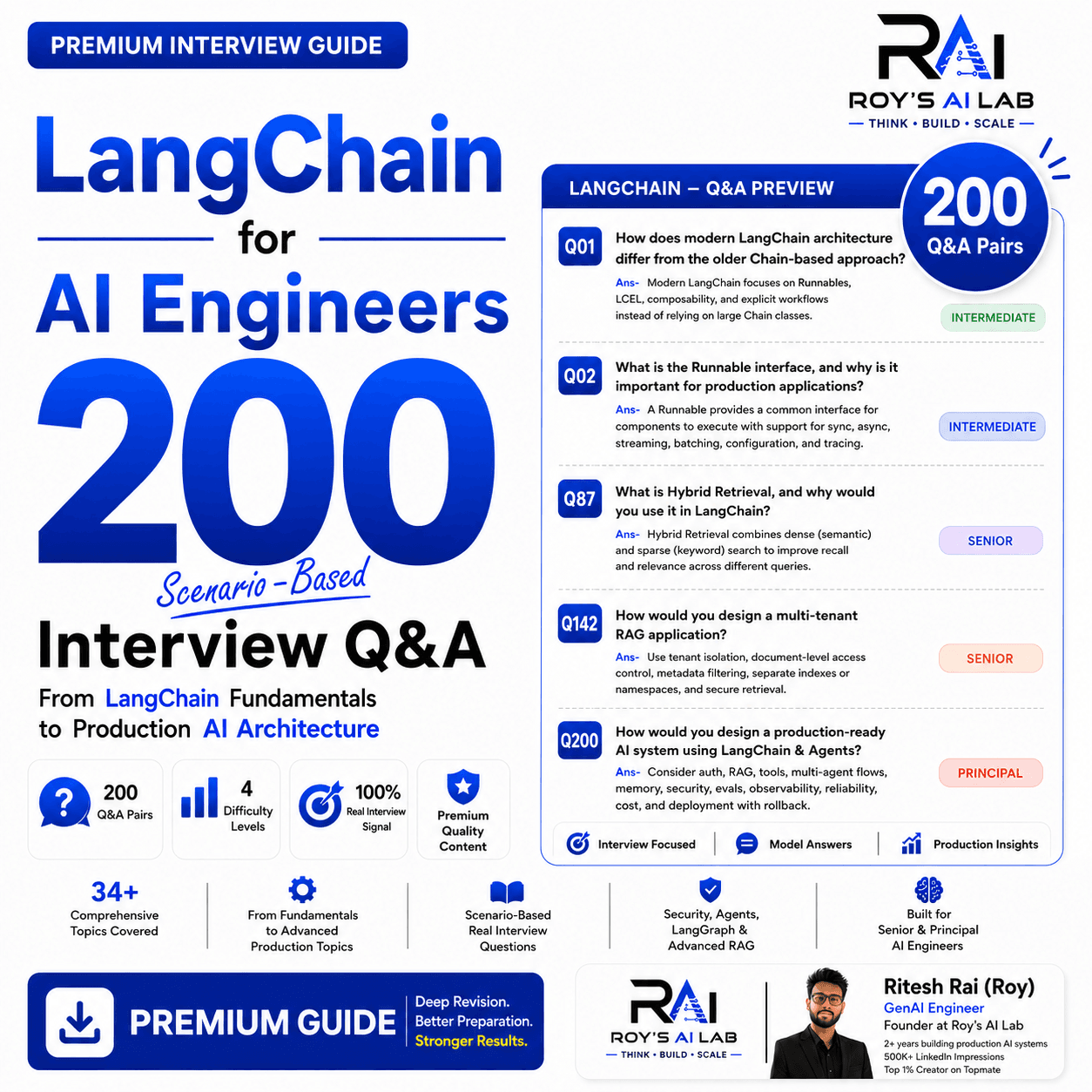
LangChain for AI Engineers: 200 Scenario-Based Production Level Interview Q&A
Master 200 real-world LangChain interview scenarios covering Production RAG, Agents, LangGraph, Security, Evaluation, and System Design for Senior & Principal AI Engineer interviews.
Preparing for Senior or Principal AI Engineer interviews where LangChain, RAG, Agents, and production AI architecture are expected? The LangChain for AI Engineers Premium Guide contains 200 real, scenario-based interview questions designed to help you prepare beyond basic framework knowledge. This isn't a collection of simple "What is LangChain?" questions. The guide focuses on the engineering decisions, trade-offs, failure scenarios, security concerns, evaluation strategies, and production architecture decisions that experienced AI Engineers are expected to understand. 📚 WHAT'S INSIDE ✅ 200 scenario-based LangChain interview Q&A ✅ 4 progressive difficulty levels ✅ Intermediate → Senior → Principal-level preparation ✅ Model answers for every question ✅ Common mistakes interviewers see ✅ Likely follow-up questions ✅ Production insights with every scenario ✅ Real-world architecture and system-design thinking ━━━━━━━━━━━━━━━━━━ 🔗 MODERN LANGCHAIN ARCHITECTURE Go beyond legacy Chain-based approaches and understand modern LangChain architecture including: • LCEL • Runnables • Runnable execution patterns • Synchronous and asynchronous execution • Streaming • Batch processing • Composable workflows • Production RAG pipelines The guide focuses on understanding how modern LangChain components fit together and why composability matters for testing, debugging, observability, and production engineering. ━━━━━━━━━━━━━━━━━━ 🧠 PRODUCTION RAG ENGINEERING Go deep into the retrieval problems that appear in real production systems: • Production RAG architecture • Chunking strategies • Semantic chunking • PDF processing • Tables, images and scanned documents • Metadata preservation • Document-level access control • Multi-tenant RAG • Hybrid retrieval • Reciprocal Rank Fusion • Reranking • Query rewriting • Conversational RAG • Multilingual RAG • Long-document retrieval • Contextual compression • Duplicate detection • Document versioning • Incremental ingestion • Document deletion • Stale information prevention • Source prioritization • Citations and source references • No-answer handling • Retrieval relevance • Retrieval regression debugging ━━━━━━━━━━━━━━━━━━ 🤖 AGENTS & AGENTIC SYSTEMS Learn how to reason about Agents beyond simply creating an Agent and giving it Tools. The guide covers: • Chain vs Agent decisions • Agent Tool permissions • Tool security • Human-in-the-Loop • Agent iteration limits • Agent loops • Agent determinism • Tool validation • Agent cost control • Multi-Agent systems • Agent routing • Agent failure handling • Agent evaluation • Production Agent architecture • When Agents should be avoided ━━━━━━━━━━━━━━━━━━ 🕸️ LANGGRAPH & STATEFUL WORKFLOWS Understand when LangChain is enough and when LangGraph becomes valuable. Topics include: • LangChain vs LangGraph • LangGraph State • Nodes and Edges • Conditional routing • Stateful workflows • Multi-Agent workflows • Persistent state • Human approval • Workflow recovery • Complex Agent orchestration LangGraph is positioned around workflows requiring multiple steps, conditional routing, loops, persistent state, human approval, multiple Agents, and recovery from failures. ━━━━━━━━━━━━━━━━━━ 🔐 SECURITY & ENTERPRISE AI Production AI systems need more than good prompts. The guide covers: • Authentication • Authorization • Document-level permissions • Multi-tenant isolation • Tool permissions • Prompt Injection defense • PII protection • Data minimization • SQL Agent security • Column-level access control • Tenant-aware SQL access • Secure Tool execution • Human approval for sensitive operations • Secure observability A recurring principle throughout the guide is that security-sensitive decisions should be enforced by deterministic application infrastructure rather than delegated to the LLM. ━━━━━━━━━━━━━━━━━━ 📊 EVALUATION & OBSERVABILITY Learn how to evaluate AI systems instead of relying only on whether the final answer "looks good." The guide covers: • RAG evaluation • Retrieval quality • Faithfulness • RAGAS • Agent evaluation • LLM-as-a-Judge • Regression testing • Evaluation datasets • A/B testing • LangSmith • Tracing • Production debugging • Retrieval metrics • Agent behavior monitoring • Quality regression detection • AI-specific CI/CD testing For production CI/CD, the guide emphasizes testing retrieval recall, answer quality, faithfulness, citation accuracy, permission isolation, Tool selection, Tool arguments, Agent termination, error handling, and budget limits. ━━━━━━━━━━━━━━━━━━ ⚡ RELIABILITY, LATENCY & COST Production AI engineering is about trade-offs. You'll work through scenarios involving: • LLM fallback strategies • Retries • Exponential backoff • Retry storms • Circuit breakers • Rate limiting • Timeouts • Cancellation • Agent iteration budgets • Token budgets • Latency optimization • Time-to-first-token • Caching • Model selection • Cost per request • Multi-provider architectures • Quality vs latency vs cost trade-offs The guide specifically approaches optimization as an engineering loop: Measure → Identify bottleneck → Change → Evaluate → Compare → Repeat. ━━━━━━━━━━━━━━━━━━ 🗄️ PRODUCTION DATA & SQL AGENTS The premium guide also goes beyond basic RAG and covers production database interactions. Topics include: • Text-to-SQL • SQL Agents • Database schema handling • SQL validation • Sensitive column protection • Multi-tenant SQL access • Row-level security • Database views • Tenant-aware caching • Safe Tool execution • SQL failure handling This makes the guide particularly useful for engineers building enterprise AI systems that interact with real business data. ━━━━━━━━━━━━━━━━━━ 🚀 PRODUCTION DEPLOYMENT & SYSTEM DESIGN The final section brings everything together into full production architecture. You'll encounter scenarios involving: • Production deployment • CI/CD for AI applications • Canary deployments • Rollbacks • Versioning • Horizontal scaling • Health checks • Multi-provider architecture • Observability • Security • Evaluation • Cost monitoring • Production incident debugging • Full-scale AI system design The final architecture scenarios require you to connect LangChain, RAG, Agents, Tools, memory, security, evaluation, observability, reliability, and deployment into one coherent production system. ━━━━━━━━━━━━━━━━━━ 🎯 WHAT MAKES THIS DIFFERENT? This is not a LangChain API cheat sheet. The guide is designed around a much more important interview skill: "What would you build, why would you build it, what trade-offs would it introduce, and what happens when it fails?" The premium questions repeatedly push you to think about: • Architecture • Reliability • Security • Scalability • Cost • Latency • Observability • Evaluation • Failure handling • Production trade-offs That is the difference between knowing a framework and being able to engineer production AI systems. ━━━━━━━━━━━━━━━━━━ 👨💻 PERFECT FOR • Senior AI Engineers • Principal AI Engineers • GenAI Engineers • Machine Learning Engineers • Software Engineers moving into GenAI • Backend Engineers building AI applications • Engineers building production RAG systems • Engineers working with AI Agents • Engineers working with LangGraph • Engineers preparing for senior-level AI interviews • Engineers preparing for system design interviews ━━━━━━━━━━━━━━━━━━ 📈 4 DIFFICULTY LEVELS The guide progresses through four levels of interview difficulty, moving from modern LangChain architecture and production concepts toward senior and principal-level system design. The goal is not simply to answer more questions. It's to progressively develop the ability to reason about production AI systems. ━━━━━━━━━━━━━━━━━━ 🔥 THE PREMIUM DIFFERENCE The Free Guide gives you the LangChain fundamentals. The Premium Edition goes much deeper into the scenarios that matter at Senior and Principal level: ✓ Advanced LangGraph and Agentic workflows ✓ Multi-Agent systems ✓ Production RAG debugging ✓ Security and multi-tenancy ✓ Evaluation and observability ✓ Cost and latency optimization ✓ Reliability and failure handling ✓ SQL Agents and enterprise data ✓ CI/CD and deployment ✓ Full production system design 200 questions. 34+ topics. 4 difficulty levels. One focused goal: Become better at answering the LangChain questions that require real engineering judgment.
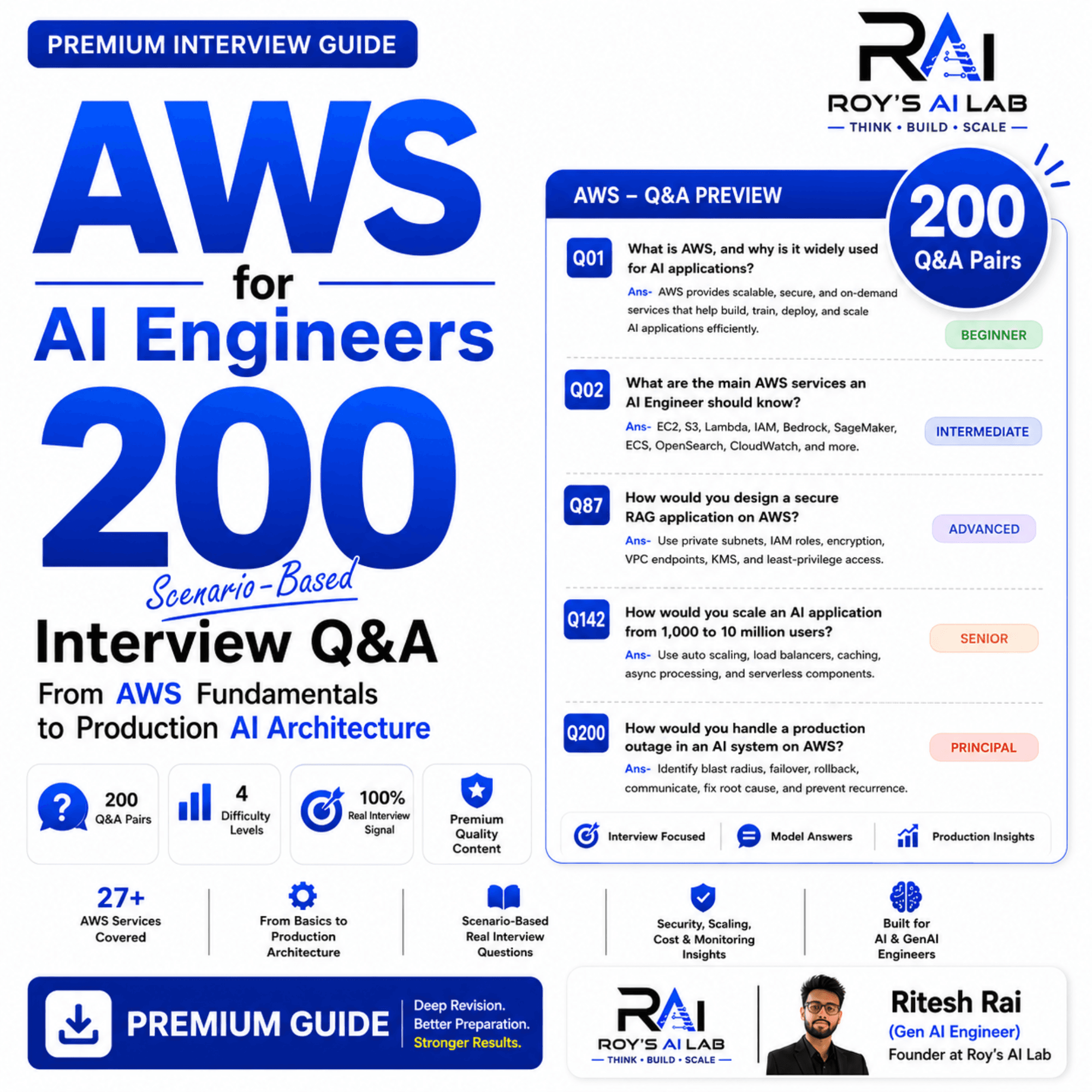
AWS for AI Engineers: 200 Scenario-Based Production Level Interview Q&A
The complete AWS interview preparation guide for AI & GenAI Engineers — with 200 real-world questions, model answers, common mistakes, follow-ups, and production insights.
Preparing for an AI Engineer or GenAI Engineer interview where AWS knowledge matters? This premium guide is designed to take your AWS interview preparation beyond basic service definitions. Inside, you'll find 200 carefully structured, scenario-based AWS interview questions covering everything from cloud fundamentals and AI services to production architecture, security, scalability, cost optimization, troubleshooting, and senior-level system design. Each question is designed around how AWS is actually used when building and deploying real AI systems. 📚 WHAT'S INSIDE ✅ 200 AWS interview Q&A pairs ✅ 4 progressive difficulty levels ✅ Beginner → Intermediate → Advanced → Senior ✅ Real scenario-based interview questions ✅ Detailed model answers ✅ Common mistakes candidates make ✅ Follow-up questions interviewers may ask ✅ Production insights for every major topic ✅ AI & GenAI-focused AWS architecture questions ✅ RAG deployment scenarios ✅ AWS Bedrock interview questions ✅ SageMaker & ML infrastructure ✅ EC2, ECS, EKS & Fargate ✅ S3, EBS & EFS ✅ OpenSearch & vector search ✅ DynamoDB & RDS ✅ Redis / ElastiCache ✅ SQS, SNS & EventBridge ✅ Lambda & Step Functions ✅ VPC, Security Groups & networking ✅ IAM, Secrets Manager & KMS ✅ CloudWatch & observability ✅ Auto Scaling & Load Balancing ✅ Route 53 & CloudFront ✅ CloudFormation & AWS CDK ✅ Docker & containerized AI deployment ✅ FastAPI deployment on AWS ✅ Production RAG architecture ✅ GPU-based LLM inference ✅ AI application security ✅ Cost optimization ✅ Performance optimization ✅ High availability & fault tolerance ✅ CI/CD & Infrastructure as Code ✅ Production troubleshooting ✅ Enterprise AI system design 🎯 WHAT MAKES THIS PREMIUM This isn't a basic AWS service cheat sheet. The questions are structured around the type of thinking expected from engineers working on production AI systems. You'll learn not only: "What does this AWS service do?" but also: "Why would I use it?" "When should I use it?" "What could go wrong?" "How would I design this in production?" "What trade-offs should I consider?" "How would I explain this to an interviewer?" Every question also includes interviewer intent, common mistakes, follow-up questions, and production-focused insights. The guide repeatedly emphasizes understanding how AWS services work together rather than simply memorizing individual services. 🏗️ PRODUCTION ARCHITECTURE COVERAGE You'll work through architectures involving combinations such as: S3 → Lambda → OpenSearch → Bedrock → ECS/Fargate → DynamoDB/Redis → CloudWatch along with IAM, Secrets Manager, KMS, Load Balancers, Auto Scaling and other production components. The guide specifically covers production RAG deployment, FastAPI deployment, AI application security, monitoring, and scalable AWS architectures. 🚀 SENIOR-LEVEL PREPARATION The later sections move beyond basic AWS knowledge into questions such as: • How would you design AWS infrastructure for ChatGPT? • How would you scale an AI application from 1,000 users to 10 million users? • How would you perform a security review before production? • How would you troubleshoot a slow AI API? • How would you respond to a production outage? • How would you optimize security, performance, cost and scalability simultaneously? • How would you defend an AWS architecture in front of a CTO? The guide emphasizes architectural reasoning, trade-offs, reliability, security, monitoring, scalability and cost — rather than simply listing AWS services. 👨💻 PERFECT FOR • AI Engineers • GenAI Engineers • Machine Learning Engineers • Software Engineers moving into AI • Backend Engineers • Cloud Engineers • Data Scientists working with AWS • Developers preparing for AWS interviews • Engineers building RAG applications • Candidates preparing for senior AI engineering roles • Anyone who wants production-focused AWS interview preparation 🎓 DIFFICULTY LEVELS LEVEL 1 — BEGINNER Build strong AWS fundamentals and understand the core services used by AI Engineers. LEVEL 2 — INTERMEDIATE Connect AWS services together and understand real deployment patterns. LEVEL 3 — ADVANCED Solve production scenarios involving performance, security, scaling, cost and troubleshooting. LEVEL 4 — SENIOR Think like a production AI Architect — system design, trade-offs, reliability, enterprise security and large-scale AI infrastructure. 💡 THE CORE IDEA Don't memorize 200 AWS definitions. Learn how to think through 200 AWS interview scenarios. By the end, you'll be better prepared to explain not only what AWS services do, but why you would choose them when designing real AI systems. 200 questions. 4 difficulty levels. One complete AWS interview preparation system for AI Engineers.
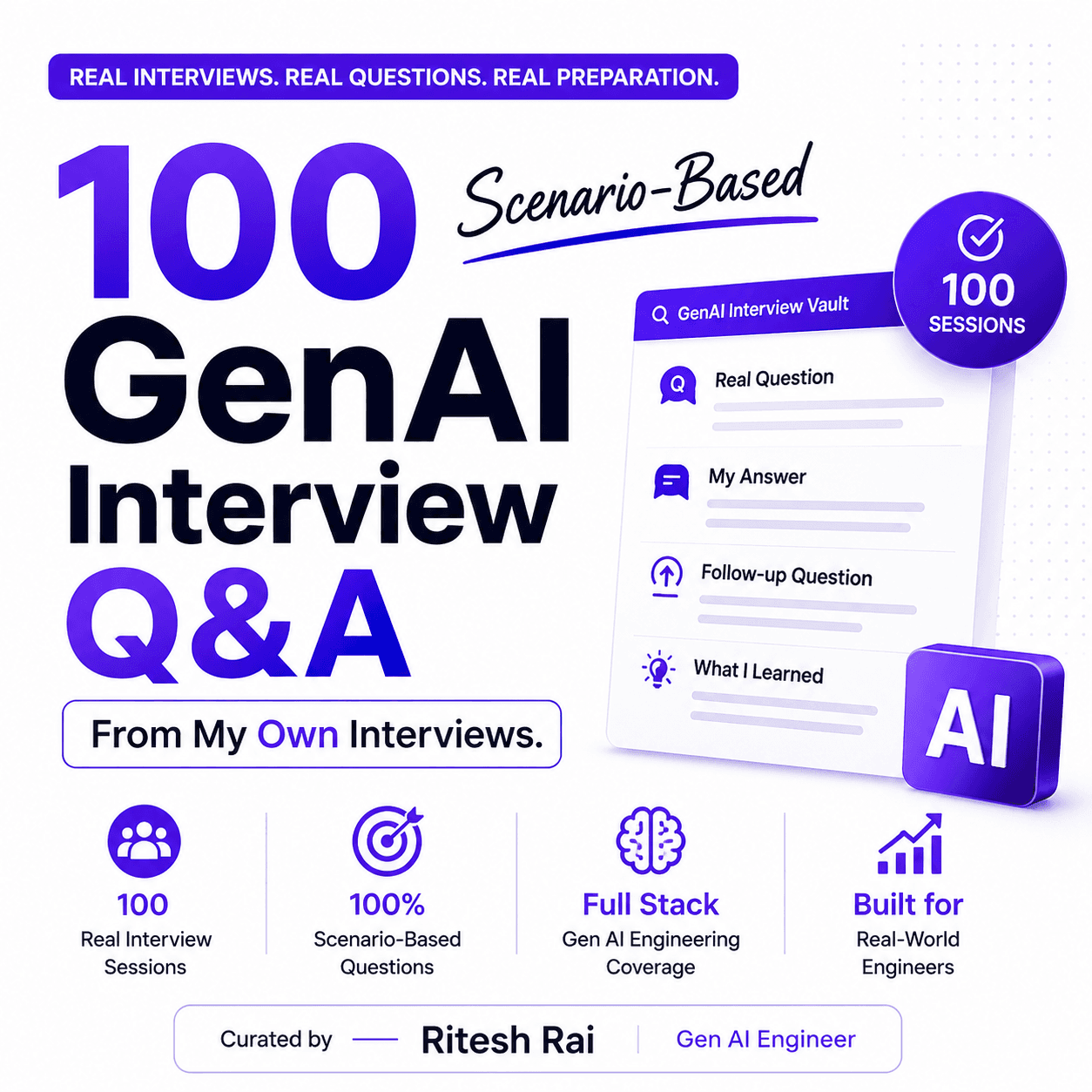
100 Scenario-Based GenAI Q&A
From My Own Interviews
100 Scenario-Based GenAI Interview Q&A - From My Own Interviews I didn't scrape these questions off the internet. Every single one was asked to me, across real Gen AI Engineer interviews, by real interviewers who weren't testing definitions. They were testing whether I actually understood the systems I claimed to have built. Some of these exact questions, when I posted them on LinkedIn, crossed 100K+ impressions on their own because engineers recognized the questions instantly. These aren't generic prep material. They're the questions actually being asked in Gen AI interviews right now. Most interview prep teaches you to explain concepts. This teaches you to survive the follow-up question - the one that comes right after your "correct" answer the one that actually decides the offer. What's inside: → 100 real scenario-based Q&A, structured exactly how the interview happened - the question, my answer, the follow-up that pushed deeper, and what I learned from it → Covers the full Gen AI engineering stack: RAG, AI Agents, LangGraph, MCP, Pydantic, FastAPI, prompt injection, guardrails, evaluation, monitoring & observability, and production system design → Every session ends with a reflection question - so you're not just reading, you're rehearsing your own answer. → Delivered as an interactive, searchable web app - not a static PDF. Filter by topic, search by keyword, track what you've reviewed Who this is for: → You're actively interviewing for Gen AI Engineer / AI Engineer / LLM Engineer roles. → You know the concepts but freeze on the "what would you actually do" follow-up → You want to sound like someone who's shipped production systems - not someone who watched a YouTube tutorial Why this is different: Some of this content already proved itself on LinkedIn, reaching 100K+ engineers organically. This isn't a guess at what interviewers ask. It's a record of what they actually asked me, validated by an audience that recognized it as real. If you want to walk into your next Gen AI interview already knowing the shape of the conversation - this is that.
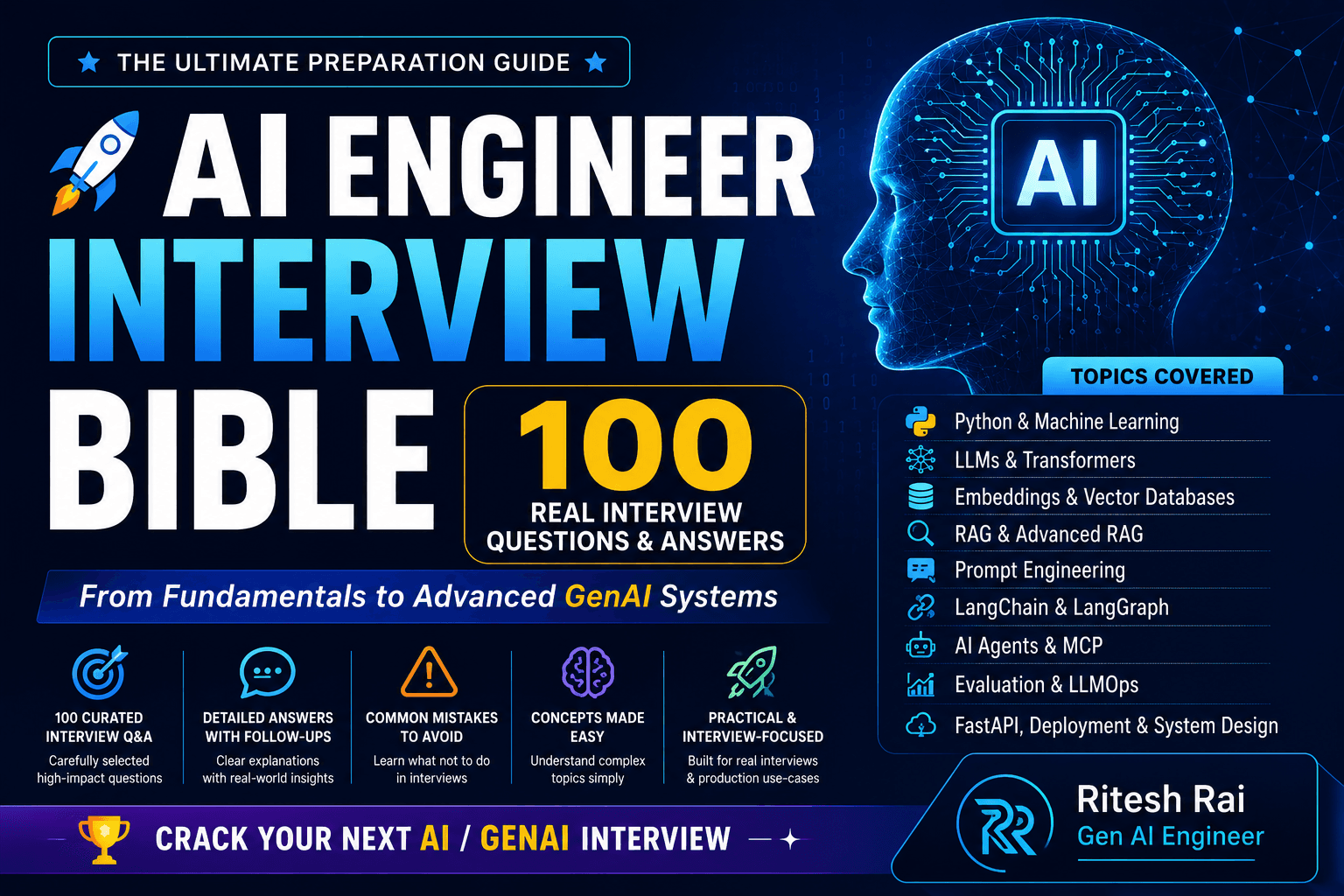
AI Engineer Interview Bible | 100 Q&A
100 Questions • Detailed Answers • Follow-ups
Preparing for AI Engineer, GenAI Engineer, or LLM roles? I've compiled 100 carefully curated interview questions with detailed answers covering everything from fundamentals to advanced GenAI concepts. 📚 Topics Covered ✅ Python ✅ Machine Learning & Deep Learning ✅ Transformers & LLM Fundamentals ✅ Embeddings & Vector Databases ✅ RAG & Advanced RAG ✅ Prompt Engineering ✅ LangChain & LangGraph ✅ AI Agents & MCP ✅ Evaluation Frameworks & LLMOps ✅ FastAPI & System Design ✅ Databases, Deployment & Production What You'll Get 🎯 100 interview questions with detailed answers 🎯 Follow-up questions asked by interviewers 🎯 Common mistakes candidates make 🎯 Practical explanations, not textbook definitions 🎯 Beginner → Advanced progression Perfect For • Aspiring AI Engineers • Gen AI Engineers • Software Engineers transitioning into AI • Data Professionals upskilling into GenAI • Anyone preparing for AI/LLM interviews One guide. 100 questions. Everything you need to walk into your next AI interview with confidence.
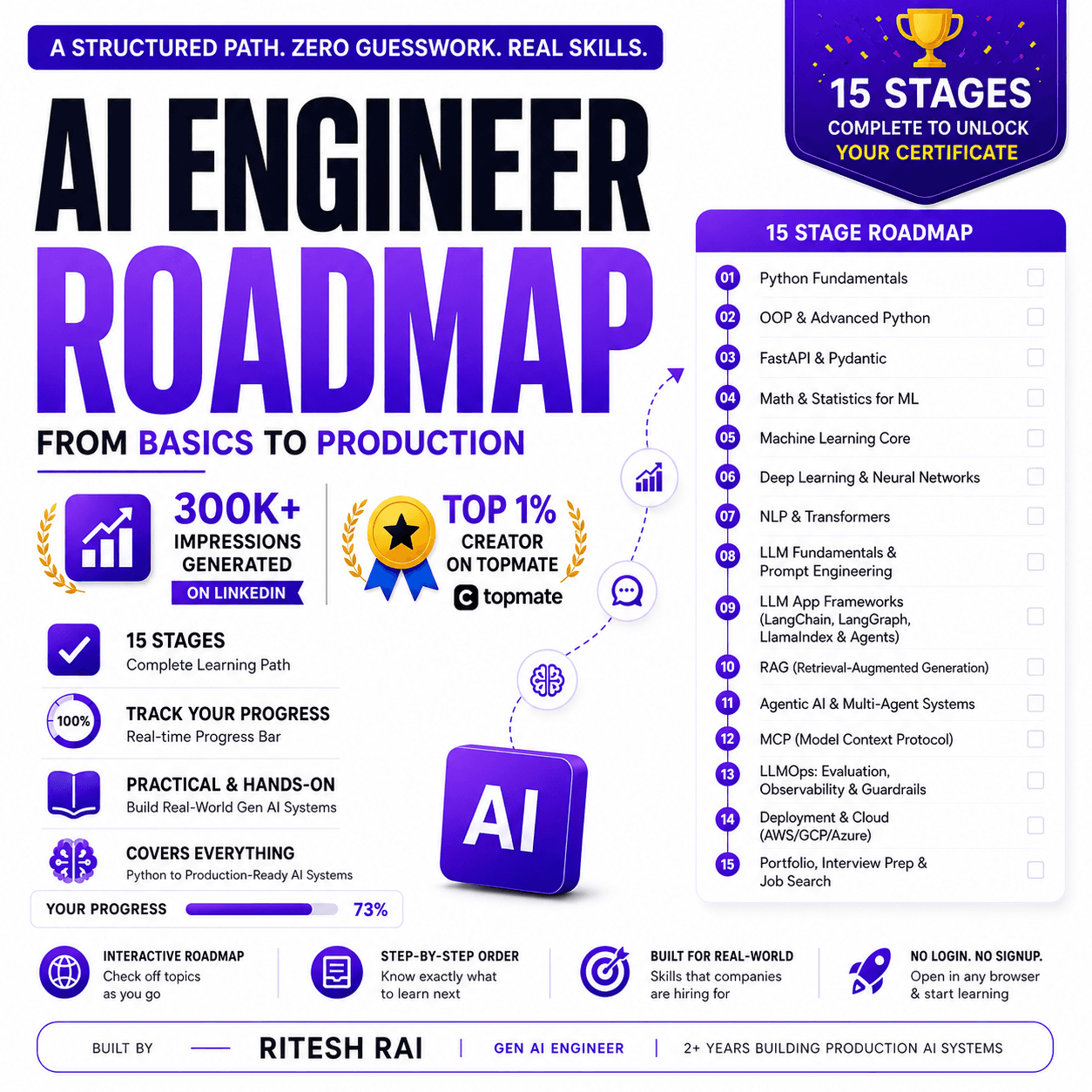
AI Engineer Roadmap - Interactive Progress Tracker
Built by AI Professionals
🚀 Stop guessing what to learn next. This is a structured, interactive roadmap that tells you exactly what to learn, in what order, to become a production-ready AI Engineer. ✅ 15 STAGES — COMPLETE LEARNING PATH: → Stage 01 — Python Fundamentals → Stage 02 — OOP & Advanced Python → Stage 03 — FastAPI & Pydantic → Stage 04 — Math & Statistics for ML → Stage 05 — Machine Learning Core → Stage 06 — Deep Learning & Neural Networks → Stage 07 — NLP & Transformers → Stage 08 — LLM Fundamentals & Prompt Engineering → Stage 09 — LLM App Frameworks (LangChain, LangGraph, LlamaIndex & Agents) → Stage 10 — RAG (Retrieval-Augmented Generation) → Stage 11 — Agentic AI & Multi-Agent Systems → Stage 12 — MCP (Model Context Protocol) → Stage 13 — LLMOps: Evaluation, Observability & Guardrails → Stage 14 — Deployment & Cloud (AWS/GCP/Azure) → Stage 15 — Portfolio, Interview Prep & Job Search ✅ WHAT'S INSIDE: → Interactive checkboxes — track your progress as you go → Progress bar showing your % completion in real time → Covers everything from Python basics to production Gen AI systems → Dark-themed, clean design — works in any browser, no login needed → Complete all 15 stages to unlock your certificate of completion ✅ WHO IS THIS FOR: → Data analysts moving into Gen AI → Software engineers learning LLM engineering → Freshers targeting AI Engineer roles → Anyone who wants a structured path — not random YouTube videos ✅ HOW IT WORKS: Download the HTML file → Open in any browser → Start checking off topics as you complete them → Watch your progress bar fill up Built by Ritesh Rai — Gen AI Engineer with 2+ years building.
Free Resources
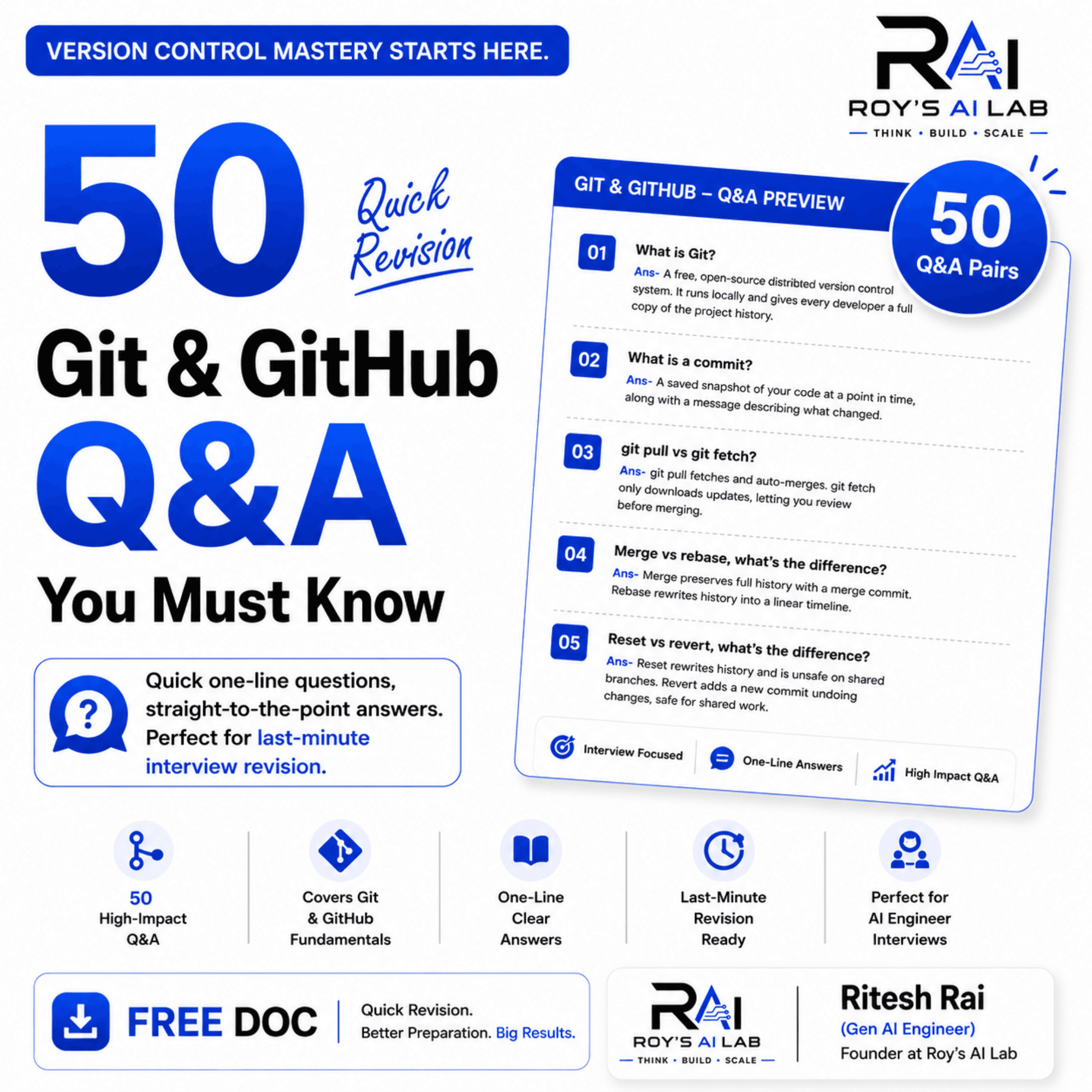
50 Quick-Fire Git & GitHub Q&A | Free Interview Prep Guide
Master the most important Git & GitHub interview questions with concise one-line answers for quick revision before your next technical interview.
Preparing for Software Engineering or AI Engineer interviews? I've compiled 50 carefully curated Git & GitHub interview questions with concise one-line answers to help you quickly revise the most important version control concepts asked in technical interviews. Whether you're preparing for AI Engineer, Software Engineer, Backend Developer, Full Stack Developer, or DevOps roles, this guide gives you a fast, interview-focused revision resource. 📚 Topics Covered :- ✅ Version Control Fundamentals ✅ Git vs GitHub ✅ Repositories & Branching ✅ Commits & Staging ✅ Git Push, Pull & Fetch ✅ Merge vs Rebase ✅ Git Stash & Reset ✅ Merge Conflicts ✅ Cherry Pick & Reflog ✅ Forks & Pull Requests ✅ .gitignore & Git Hooks ✅ Git LFS ✅ GitHub Actions ✅ CI/CD Fundamentals ✅ SSH Authentication What You'll Get 🎯 50 high-impact interview questions 🎯 Concise one-line answers for quick revision 🎯 Covers Git fundamentals through advanced workflows 🎯 Beginner-friendly and interview-focused 🎯 Perfect for last-minute interview preparation Perfect For • AI Engineers • Software Engineers • Backend Developers • Full Stack Developers • DevOps Engineers • Freshers preparing for technical interviews • Anyone who wants to master Git & GitHub fundamentals One guide. 50 essential questions. Everything you need to confidently answer Git & GitHub interview questions in your next technical interview.
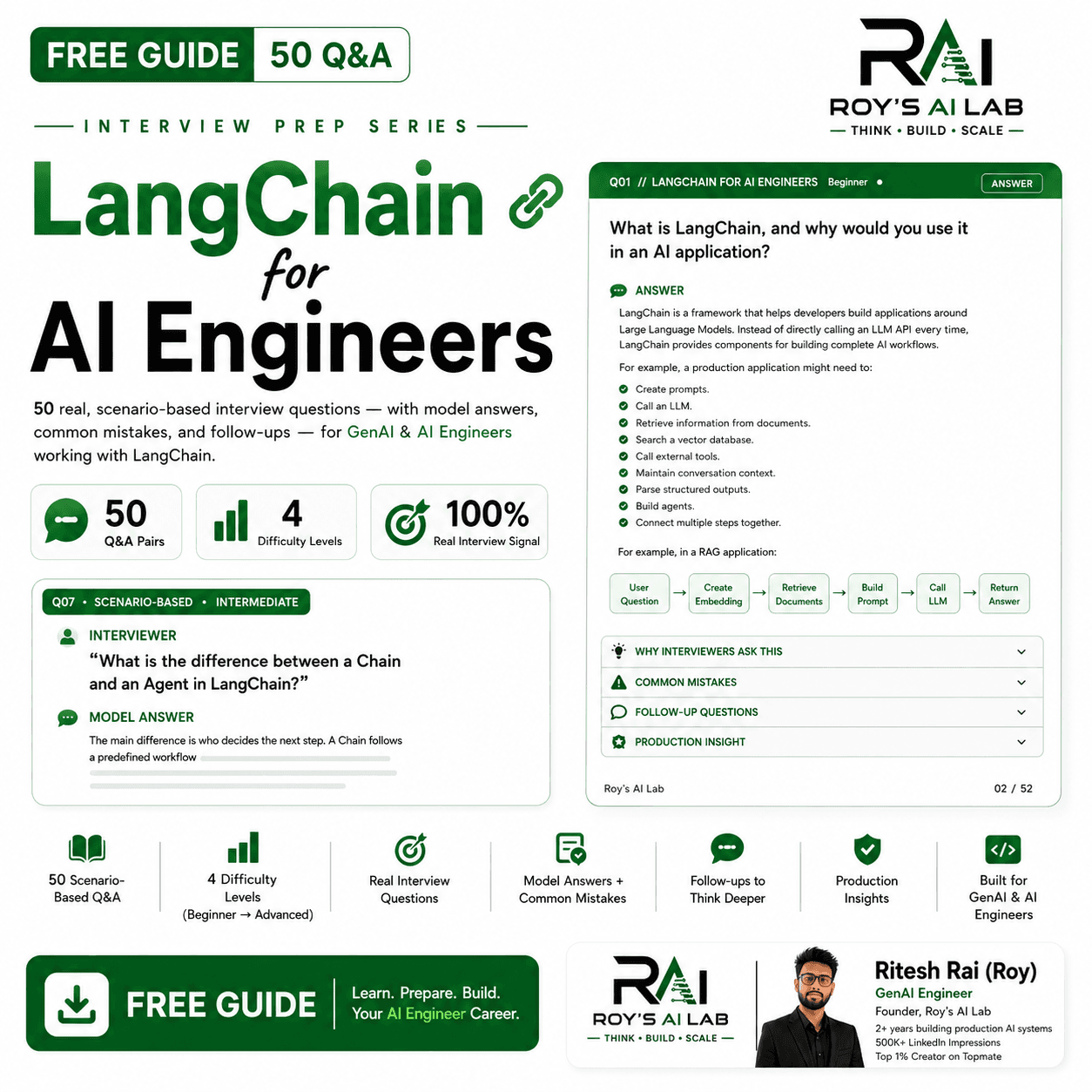
LangChain for AI Engineers: 50 Scenario-Based Production Level Interview Q&A
Master the most important LangChain interview concepts with 50 scenario-based questions, model answers, common mistakes, follow-ups, and production insights.
Preparing for AI Engineer or GenAI Engineer interviews where LangChain knowledge matters? I've compiled 50 carefully structured, scenario-based LangChain interview questions with model answers, common mistakes, follow-up questions, and production insights to help you prepare for real AI Engineering interviews. This guide goes beyond simply memorizing LangChain classes. The questions are designed to help you understand how LangChain components work together when building real AI applications, RAG systems, Agentic workflows, and production-ready GenAI applications. 📚 WHAT'S INSIDE ✅ 50 scenario-based LangChain interview Q&A ✅ 4 progressive difficulty levels ✅ Beginner → Intermediate → Senior → Principal ✅ Model answers for every question ✅ Common mistakes candidates make ✅ Likely follow-up questions ✅ Production insights throughout the guide ✅ LangChain fundamentals and core components ✅ Prompt Templates and Chat Models ✅ Chains, LCEL and Runnables ✅ RunnableSequence, RunnableParallel & RunnablePassthrough ✅ Documents and Document Loaders ✅ Text Splitting and Chunk Overlap ✅ Embeddings and Vector Stores ✅ Retrievers and Similarity Search ✅ Top-K Retrieval ✅ RAG architecture and production RAG ✅ RAG vs Fine-Tuning ✅ Conversational RAG ✅ MultiQuery Retrieval ✅ Metadata Filtering ✅ Reranking ✅ Contextual Compression ✅ Hallucination reduction ✅ RAG evaluation and production metrics ✅ Agents and Tools ✅ Tool Calling ✅ Agent decision-making ✅ Agent loop control ✅ Memory and conversation state ✅ Streaming ✅ Error handling and retries ✅ LangSmith and observability ✅ Multi-tenant RAG architecture ✅ Production deployment ✅ Security and authorization ✅ Monitoring and evaluation ✅ Cost and latency considerations 🏗️ PRODUCTION-FOCUSED PREPARATION The guide doesn't stop at basic LangChain definitions. You'll encounter practical questions around building and operating real systems, including: • How would you build a LangChain RAG application in production? • How would you reduce hallucinations? • How would you evaluate a RAG application? • How would you handle failures and retries? • How would you prevent an Agent from running forever? • How would you design a multi-tenant RAG application? • How would you deploy LangChain to production? • How would you design a production-ready LangChain application? The final production architecture question brings together authentication, authorization, retrieval, vector stores, model providers, validation, evaluation, observability, monitoring, rate limiting, error handling, streaming, CI/CD, containerized deployment, and cost monitoring. 🎯 WHAT MAKES THIS GUIDE DIFFERENT This isn't just a LangChain cheat sheet. The questions are designed around the type of reasoning expected from AI Engineers working with LangChain in real applications. You'll learn to think beyond: "What is this LangChain component?" and start thinking: "Why would I use it?" "When should I use it?" "What could go wrong?" "How would I improve the system?" "How would I make it production-ready?" "How would I explain this to an interviewer?" Every question includes additional interview context through common mistakes, follow-up questions, and production-focused insights. 👨💻 PERFECT FOR • AI Engineers • GenAI Engineers • Machine Learning Engineers • Software Engineers moving into AI • Backend Engineers building GenAI applications • Developers working with LangChain • Engineers building RAG applications • Engineers working with AI Agents • Freshers preparing for AI Engineering interviews • Anyone looking to strengthen their LangChain fundamentals 🎓 DIFFICULTY LEVELS LEVEL 1 — BEGINNER Build a strong foundation in LangChain and understand its core components. LEVEL 2 — INTERMEDIATE Understand workflows, RAG pipelines, retrieval, LCEL, Runnables, Agents, and Tools. LEVEL 3 — SENIOR Move into production concerns such as evaluation, observability, streaming, security, error handling, retrieval optimization, and Agent reliability. LEVEL 4 — PRINCIPAL Think beyond individual components and design complete, production-ready LangChain systems. 🚀 THE CORE IDEA Don't memorize 50 LangChain definitions. Learn how to think through 50 LangChain interview scenarios. By the end of this guide, you'll have a stronger understanding of how LangChain fits into real AI applications, RAG pipelines, Agentic workflows, and production AI systems. 50 questions. 4 difficulty levels. One focused LangChain interview preparation guide. And best of all... It's completely FREE.
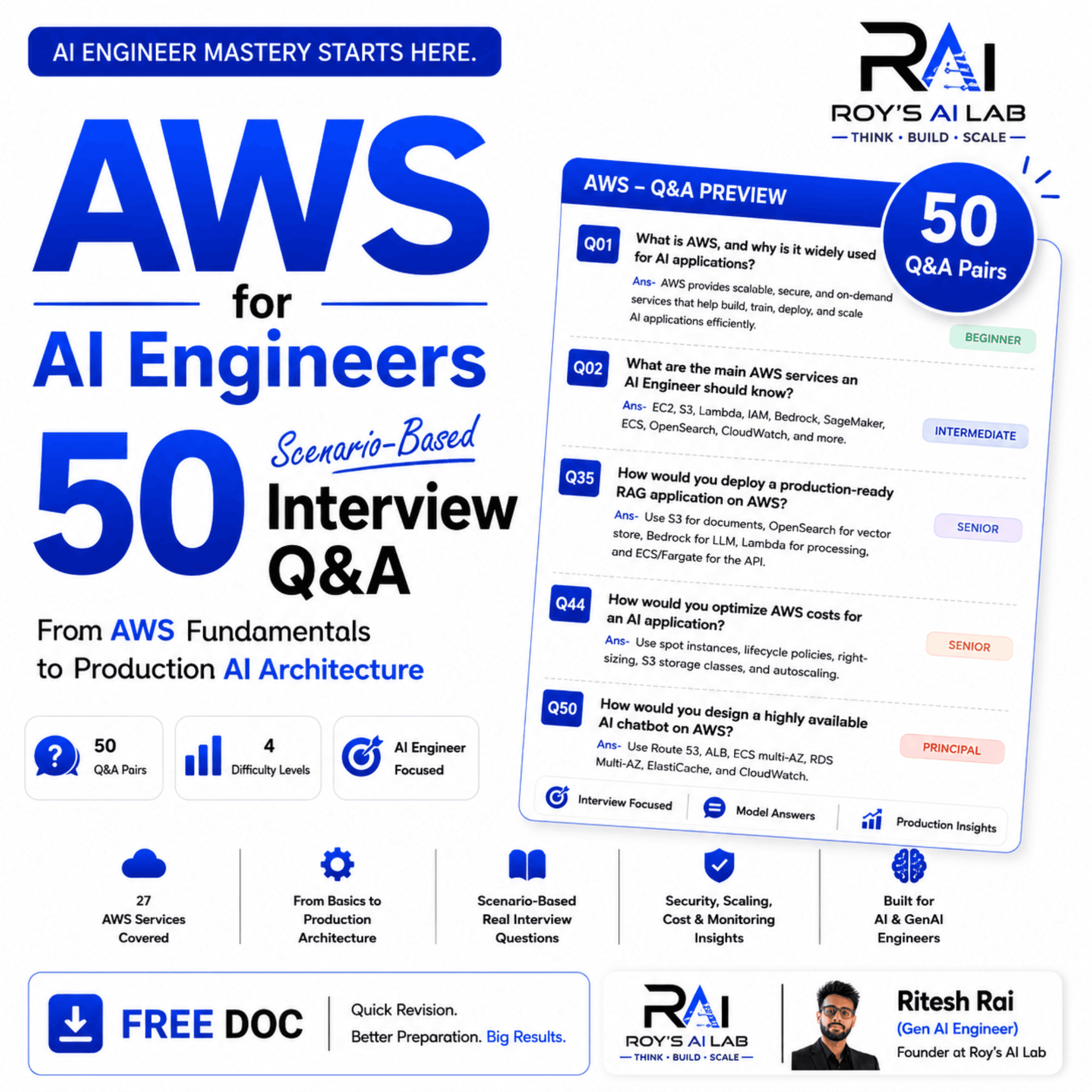
AWS for AI Engineers: 50 Scenario-Based Production Level Interview Q&A
Master AWS for AI & GenAI interviews with 50 real-world questions covering cloud fundamentals, Bedrock, RAG, deployment, security, scaling, cost optimization, and production architecture.
Preparing for AI Engineer, GenAI Engineer, or Machine Learning Engineer interviews where AWS is part of the stack? This guide gives you 50 carefully structured AWS interview questions designed specifically for AI Engineers — from core AWS fundamentals to real production architecture and system-design scenarios. Instead of memorizing AWS service definitions, you'll learn how different AWS services fit together in real AI applications and how to explain those decisions confidently in an interview. 📚 WHAT'S COVERED ✅ AWS & Cloud Fundamentals ✅ EC2, S3, IAM & Lambda ✅ API Gateway & VPC ✅ Security Groups & Networking ✅ ECR, ECS, EKS & Fargate ✅ SageMaker & Amazon Bedrock ✅ OpenSearch & RAG Architecture ✅ DynamoDB & RDS ✅ Redis / ElastiCache ✅ SQS, SNS & EventBridge ✅ AWS Step Functions ✅ Auto Scaling & Load Balancers ✅ Route 53 & CloudFront ✅ Secrets Manager & KMS ✅ CloudFormation & AWS CDK ✅ EBS & EFS ✅ Production RAG Deployment ✅ FastAPI Deployment on AWS ✅ AI Application Security ✅ High Availability & Fault Tolerance ✅ Cost Optimization & Spot Instances ✅ Production Troubleshooting ✅ AI Chatbot & Document Chatbot Architecture 🎯 WHAT YOU'LL GET • 50 AWS interview questions • Scenario-based model answers • Beginner to Principal-level difficulty • Common interview mistakes for each question • Follow-up questions interviewers may ask • Production insights based on real AI architecture patterns • AWS service selection guidance • End-to-end AI system design scenarios • RAG and GenAI deployment architecture • Security, scalability, monitoring and cost-optimization concepts 💡 WHY THIS GUIDE IS DIFFERENT This isn't a list of AWS definitions. The questions are designed around how AWS is actually used in AI applications. You'll learn how services such as: S3 → Lambda → OpenSearch → Bedrock → ECS → CloudWatch → IAM can work together as part of a production AI architecture. The guide also covers the reasoning behind architectural decisions — exactly the type of thinking expected from AI Engineers during technical interviews. 👨💻 PERFECT FOR • AI Engineers • GenAI Engineers • Machine Learning Engineers • Software Engineers moving into AI • Backend Engineers working with AI systems • Cloud Engineers • Data Scientists working with AWS • Developers preparing for AWS-focused AI interviews • Candidates with 1–5 years of experience 🚀 INTERVIEW TOPICS INCLUDE From basic questions like "What is EC2?" and "What is S3?" to senior-level scenarios such as: • How would you deploy a production-ready RAG application on AWS? • How would you secure an AI application running on AWS? • How would you build a scalable AI chatbot? • How would you design an AI document chatbot? • How would you troubleshoot a slow AI API? • How would you optimize AWS costs for an AI application? • How would you handle high availability and server failures? One guide. 50 questions. A complete AWS interview revision path for AI Engineers.
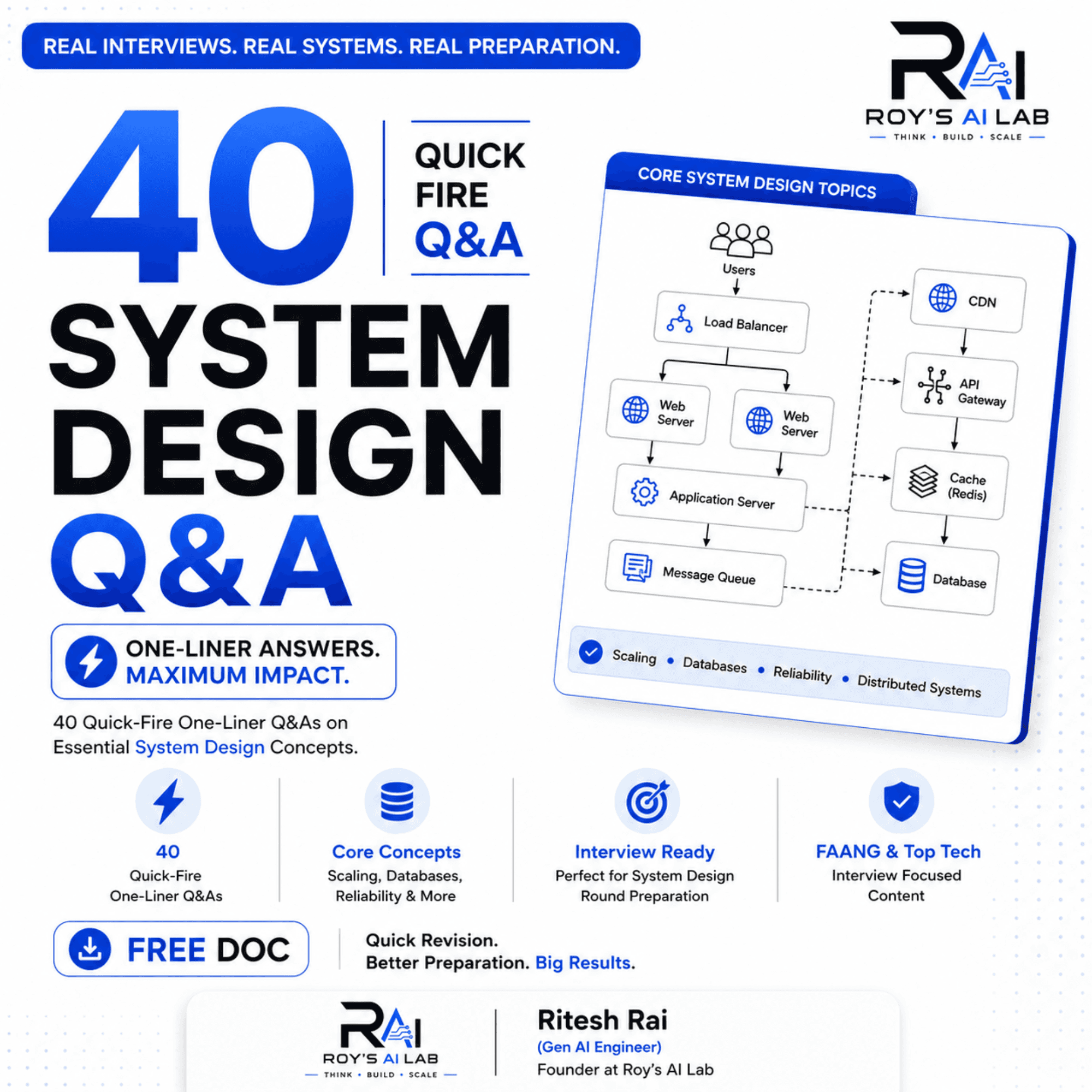
40 Quick-Fire System Design Q&A | Free Interview Prep Guide
Your free quick-reference guide to the 40 most important System Design interview concepts.
Preparing for System Design interviews? I've compiled 40 carefully curated System Design interview questions with concise one-line answers to help you quickly revise the most important concepts asked in software engineering interviews. 📚 Topics Covered ✅ Scaling (Horizontal & Vertical) ✅ Load Balancing & Reverse Proxy ✅ CDN & Caching ✅ Cache Invalidation ✅ Database Sharding & Replication ✅ Distributed Systems ✅ CAP Theorem & Consistency ✅ Message Queues & API Gateway ✅ Rate Limiting & Circuit Breakers ✅ High Availability & Fault Tolerance ✅ Database Partitioning ✅ Deployment Strategies ✅ System Design Fundamentals What You'll Get 🎯 40 high-frequency System Design interview questions 🎯 Concise one-line answers for quick revision 🎯 Core concepts explained in an interview-friendly format 🎯 Beginner-friendly, easy-to-understand explanations 🎯 Perfect for last-minute interview preparation Perfect For • Software Engineers • Backend Engineers • Full Stack Developers • SDE-1 & SDE-2 Aspirants • FAANG & Product-Based Company Candidates • Anyone preparing for System Design interviews One guide. 40 essential questions. Everything you need to quickly revise the fundamentals of System Design before your next interview. Claim for Free
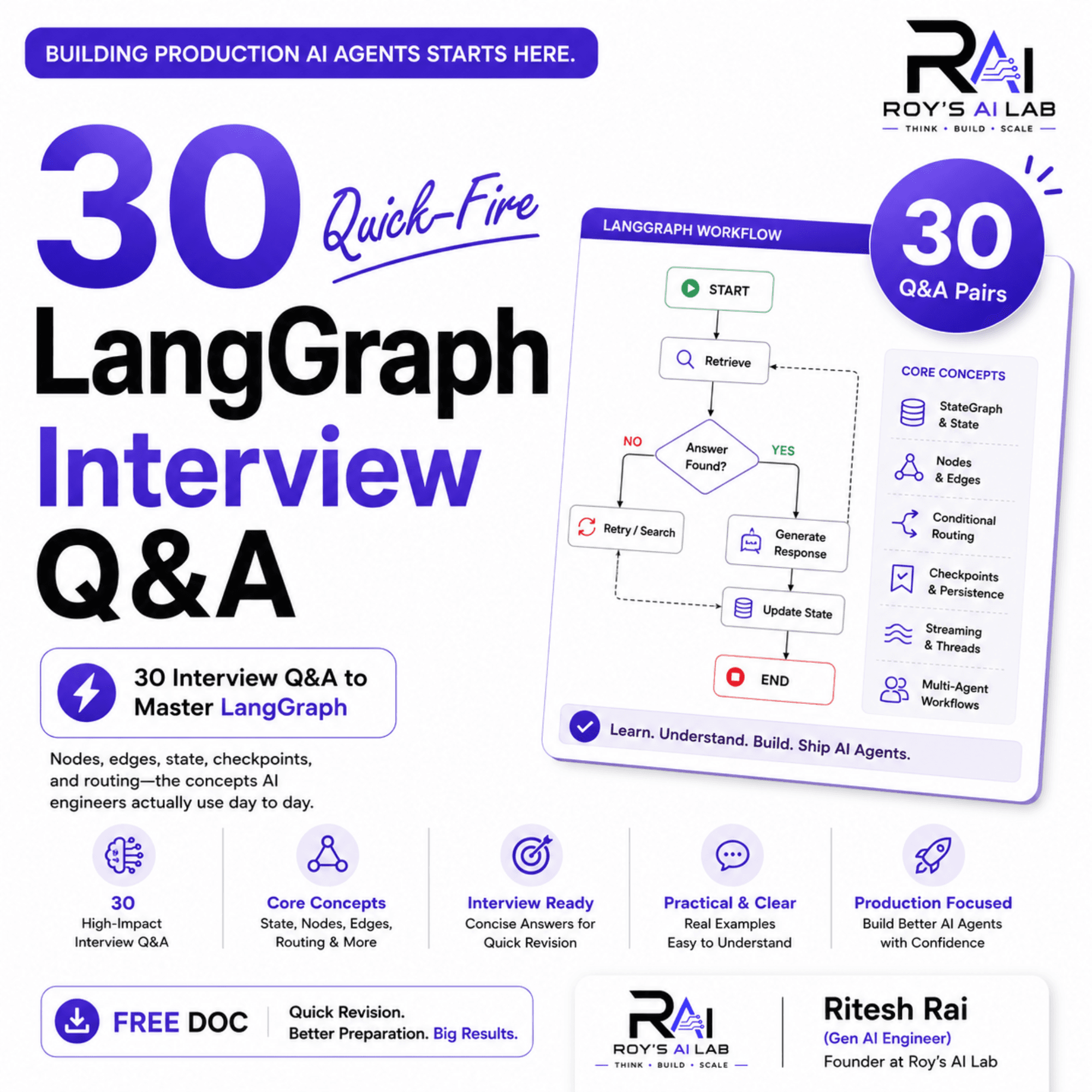
30 Quick-Fire LangGraph Interview Q&A | Free AI Agent Guide
Master LangGraph fundamentals, workflows, state management, routing, and AI agent concepts with 30 concise interview-ready Q&A.
Preparing for AI Agent or LangGraph interviews? I've compiled 30 carefully curated LangGraph interview questions with concise, interview-focused answers to help you quickly master the concepts that AI Engineers use in real-world applications. 📚 Topics Covered ✅ LangGraph Fundamentals ✅ StateGraph & MessagesState ✅ Nodes & Edges ✅ Conditional Routing ✅ START & END Nodes ✅ Graph Compilation & Execution ✅ State Management ✅ Checkpointing & Persistence ✅ Thread IDs ✅ Streaming ✅ Reducers ✅ Human-in-the-Loop Workflows ✅ Multi-Agent Architecture ✅ Supervisor & Router Patterns ✅ ToolNode & ReAct Agents ✅ Error Handling & Retry Logic ✅ Production Debugging What You'll Get 🎯 30 high-frequency LangGraph interview questions 🎯 Concise interview-ready answers 🎯 Production-focused AI agent concepts 🎯 Beginner-friendly explanations with practical examples 🎯 Perfect for quick revision before interviews Perfect For • AI Engineers • GenAI Engineers • LLM Engineers • Agentic AI Developers • Software Engineers building AI Agents • Anyone preparing for LangGraph interviews One guide. 30 essential questions. Everything you need to confidently discuss LangGraph in your next AI Engineer interview.
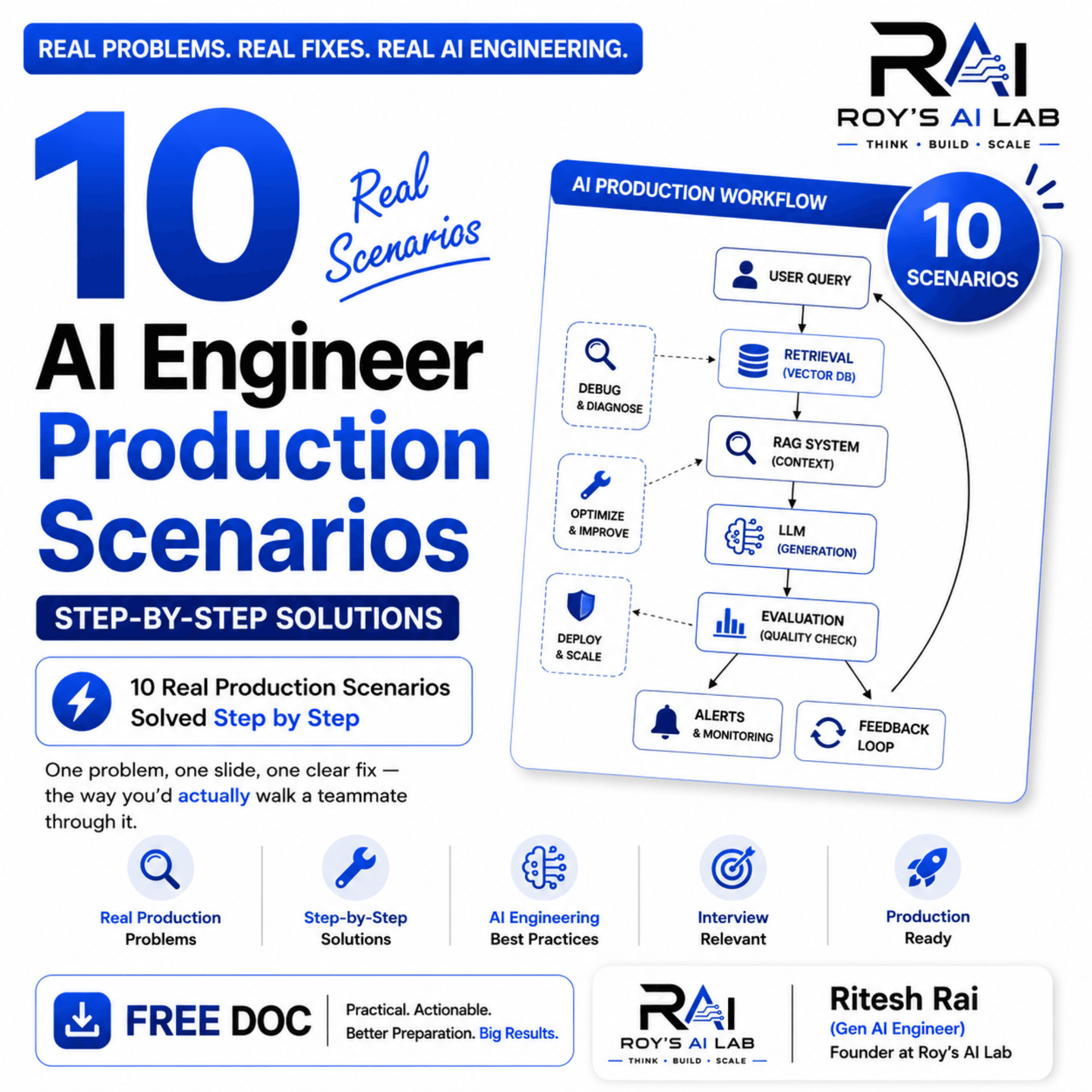
10 Most Frequent Asked AI Engineer Production Scenarios | Step-by-Step Solutions
Learn how experienced AI Engineers diagnose and solve real production problems in RAG, LLMs, AI Agents, and GenAI systems.
Preparing for AI Engineer or GenAI interviews? I've compiled 10 real production AI engineering scenarios with practical, step-by-step solutions based on the kinds of problems AI Engineers solve in production systems. Instead of memorizing theory, you'll learn how to think through debugging, optimization, evaluation, and deployment challenges that frequently appear in interviews and real-world AI applications. 📚 Topics Covered ✅ Hallucination Reduction in RAG ✅ Production Evaluation ✅ Multi-Agent Debugging ✅ LLM Cost Optimization ✅ Prompt Injection & Security ✅ Vector Search Optimization ✅ Latency Reduction ✅ Production Monitoring ✅ Retrieval Quality Improvement ✅ AI System Reliability What You'll Get 🎯 10 real production scenarios 🎯 Step-by-step debugging approach 🎯 Interview-focused problem-solving 🎯 Practical AI engineering best practices 🎯 Production-ready troubleshooting techniques Perfect For • AI Engineers • GenAI Engineers • LLM Engineers • RAG Developers • Agentic AI Developers • Software Engineers building AI products • Anyone preparing for AI Engineering interviews One guide. 10 real production scenarios. Learn how experienced AI Engineers diagnose, debug, and solve real-world AI system failures with confidence.