 Roy's AI Lab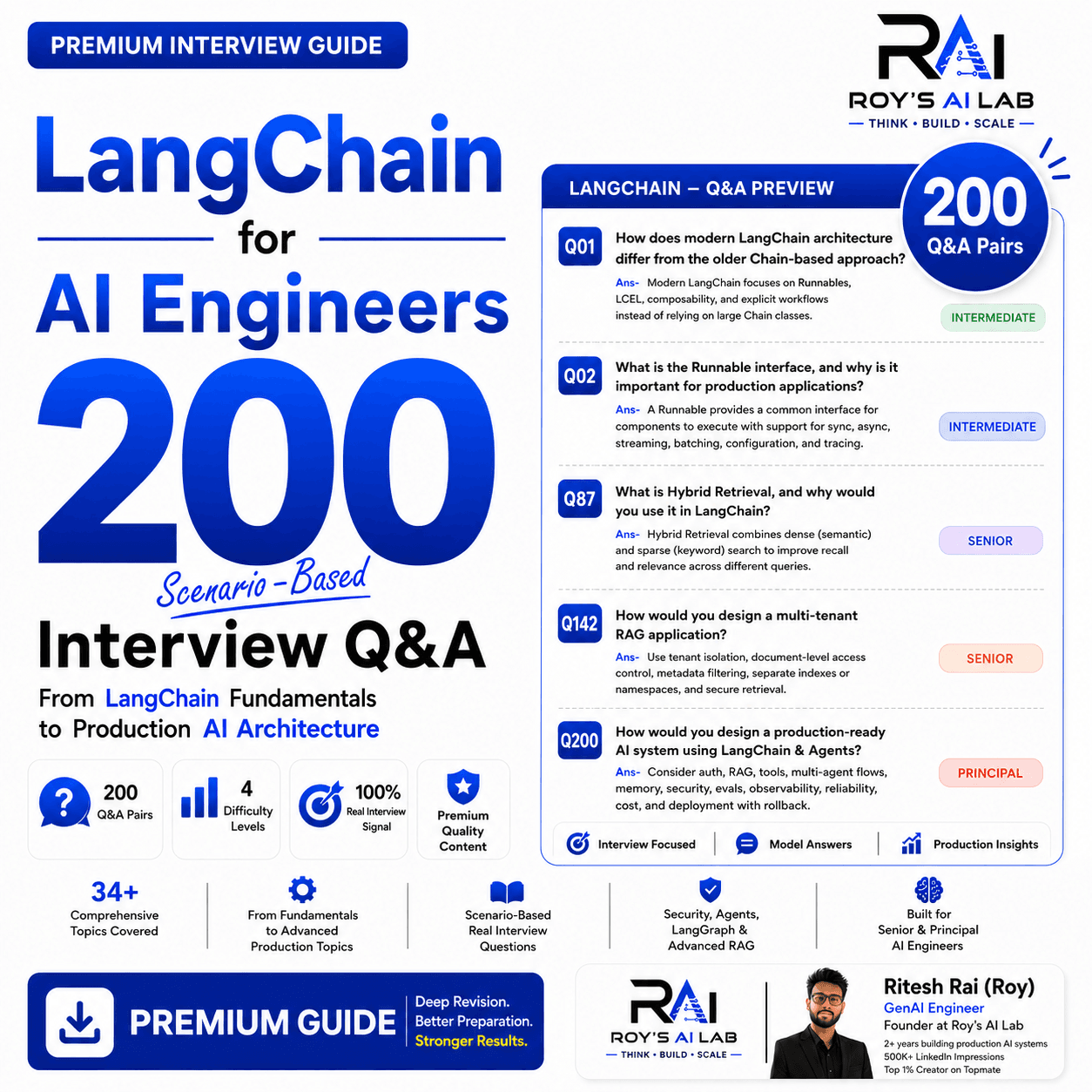
LangChain for AI Engineers: 200 Scenario-Based Production Level Interview Q&A
Master 200 real-world LangChain interview scenarios covering Production RAG, Agents, LangGraph, Security, Evaluation, and System Design for Senior & Principal AI Engineer interviews.
Preparing for Senior or Principal AI Engineer interviews where LangChain, RAG, Agents, and production AI architecture are expected? The LangChain for AI Engineers Premium Guide contains 200 real, scenario-based interview questions designed to help you prepare beyond basic framework knowledge. This isn't a collection of simple "What is LangChain?" questions. The guide focuses on the engineering decisions, trade-offs, failure scenarios, security concerns, evaluation strategies, and production architecture decisions that experienced AI Engineers are expected to understand. 📚 WHAT'S INSIDE ✅ 200 scenario-based LangChain interview Q&A ✅ 4 progressive difficulty levels ✅ Intermediate → Senior → Principal-level preparation ✅ Model answers for every question ✅ Common mistakes interviewers see ✅ Likely follow-up questions ✅ Production insights with every scenario ✅ Real-world architecture and system-design thinking ━━━━━━━━━━━━━━━━━━ 🔗 MODERN LANGCHAIN ARCHITECTURE Go beyond legacy Chain-based approaches and understand modern LangChain architecture including: • LCEL • Runnables • Runnable execution patterns • Synchronous and asynchronous execution • Streaming • Batch processing • Composable workflows • Production RAG pipelines The guide focuses on understanding how modern LangChain components fit together and why composability matters for testing, debugging, observability, and production engineering. ━━━━━━━━━━━━━━━━━━ 🧠 PRODUCTION RAG ENGINEERING Go deep into the retrieval problems that appear in real production systems: • Production RAG architecture • Chunking strategies • Semantic chunking • PDF processing • Tables, images and scanned documents • Metadata preservation • Document-level access control • Multi-tenant RAG • Hybrid retrieval • Reciprocal Rank Fusion • Reranking • Query rewriting • Conversational RAG • Multilingual RAG • Long-document retrieval • Contextual compression • Duplicate detection • Document versioning • Incremental ingestion • Document deletion • Stale information prevention • Source prioritization • Citations and source references • No-answer handling • Retrieval relevance • Retrieval regression debugging ━━━━━━━━━━━━━━━━━━ 🤖 AGENTS & AGENTIC SYSTEMS Learn how to reason about Agents beyond simply creating an Agent and giving it Tools. The guide covers: • Chain vs Agent decisions • Agent Tool permissions • Tool security • Human-in-the-Loop • Agent iteration limits • Agent loops • Agent determinism • Tool validation • Agent cost control • Multi-Agent systems • Agent routing • Agent failure handling • Agent evaluation • Production Agent architecture • When Agents should be avoided ━━━━━━━━━━━━━━━━━━ 🕸️ LANGGRAPH & STATEFUL WORKFLOWS Understand when LangChain is enough and when LangGraph becomes valuable. Topics include: • LangChain vs LangGraph • LangGraph State • Nodes and Edges • Conditional routing • Stateful workflows • Multi-Agent workflows • Persistent state • Human approval • Workflow recovery • Complex Agent orchestration LangGraph is positioned around workflows requiring multiple steps, conditional routing, loops, persistent state, human approval, multiple Agents, and recovery from failures. ━━━━━━━━━━━━━━━━━━ 🔐 SECURITY & ENTERPRISE AI Production AI systems need more than good prompts. The guide covers: • Authentication • Authorization • Document-level permissions • Multi-tenant isolation • Tool permissions • Prompt Injection defense • PII protection • Data minimization • SQL Agent security • Column-level access control • Tenant-aware SQL access • Secure Tool execution • Human approval for sensitive operations • Secure observability A recurring principle throughout the guide is that security-sensitive decisions should be enforced by deterministic application infrastructure rather than delegated to the LLM. ━━━━━━━━━━━━━━━━━━ 📊 EVALUATION & OBSERVABILITY Learn how to evaluate AI systems instead of relying only on whether the final answer "looks good." The guide covers: • RAG evaluation • Retrieval quality • Faithfulness • RAGAS • Agent evaluation • LLM-as-a-Judge • Regression testing • Evaluation datasets • A/B testing • LangSmith • Tracing • Production debugging • Retrieval metrics • Agent behavior monitoring • Quality regression detection • AI-specific CI/CD testing For production CI/CD, the guide emphasizes testing retrieval recall, answer quality, faithfulness, citation accuracy, permission isolation, Tool selection, Tool arguments, Agent termination, error handling, and budget limits. ━━━━━━━━━━━━━━━━━━ ⚡ RELIABILITY, LATENCY & COST Production AI engineering is about trade-offs. You'll work through scenarios involving: • LLM fallback strategies • Retries • Exponential backoff • Retry storms • Circuit breakers • Rate limiting • Timeouts • Cancellation • Agent iteration budgets • Token budgets • Latency optimization • Time-to-first-token • Caching • Model selection • Cost per request • Multi-provider architectures • Quality vs latency vs cost trade-offs The guide specifically approaches optimization as an engineering loop: Measure → Identify bottleneck → Change → Evaluate → Compare → Repeat. ━━━━━━━━━━━━━━━━━━ 🗄️ PRODUCTION DATA & SQL AGENTS The premium guide also goes beyond basic RAG and covers production database interactions. Topics include: • Text-to-SQL • SQL Agents • Database schema handling • SQL validation • Sensitive column protection • Multi-tenant SQL access • Row-level security • Database views • Tenant-aware caching • Safe Tool execution • SQL failure handling This makes the guide particularly useful for engineers building enterprise AI systems that interact with real business data. ━━━━━━━━━━━━━━━━━━ 🚀 PRODUCTION DEPLOYMENT & SYSTEM DESIGN The final section brings everything together into full production architecture. You'll encounter scenarios involving: • Production deployment • CI/CD for AI applications • Canary deployments • Rollbacks • Versioning • Horizontal scaling • Health checks • Multi-provider architecture • Observability • Security • Evaluation • Cost monitoring • Production incident debugging • Full-scale AI system design The final architecture scenarios require you to connect LangChain, RAG, Agents, Tools, memory, security, evaluation, observability, reliability, and deployment into one coherent production system. ━━━━━━━━━━━━━━━━━━ 🎯 WHAT MAKES THIS DIFFERENT? This is not a LangChain API cheat sheet. The guide is designed around a much more important interview skill: "What would you build, why would you build it, what trade-offs would it introduce, and what happens when it fails?" The premium questions repeatedly push you to think about: • Architecture • Reliability • Security • Scalability • Cost • Latency • Observability • Evaluation • Failure handling • Production trade-offs That is the difference between knowing a framework and being able to engineer production AI systems. ━━━━━━━━━━━━━━━━━━ 👨💻 PERFECT FOR • Senior AI Engineers • Principal AI Engineers • GenAI Engineers • Machine Learning Engineers • Software Engineers moving into GenAI • Backend Engineers building AI applications • Engineers building production RAG systems • Engineers working with AI Agents • Engineers working with LangGraph • Engineers preparing for senior-level AI interviews • Engineers preparing for system design interviews ━━━━━━━━━━━━━━━━━━ 📈 4 DIFFICULTY LEVELS The guide progresses through four levels of interview difficulty, moving from modern LangChain architecture and production concepts toward senior and principal-level system design. The goal is not simply to answer more questions. It's to progressively develop the ability to reason about production AI systems. ━━━━━━━━━━━━━━━━━━ 🔥 THE PREMIUM DIFFERENCE The Free Guide gives you the LangChain fundamentals. The Premium Edition goes much deeper into the scenarios that matter at Senior and Principal level: ✓ Advanced LangGraph and Agentic workflows ✓ Multi-Agent systems ✓ Production RAG debugging ✓ Security and multi-tenancy ✓ Evaluation and observability ✓ Cost and latency optimization ✓ Reliability and failure handling ✓ SQL Agents and enterprise data ✓ CI/CD and deployment ✓ Full production system design 200 questions. 34+ topics. 4 difficulty levels. One focused goal: Become better at answering the LangChain questions that require real engineering judgment.