 Roy's AI Lab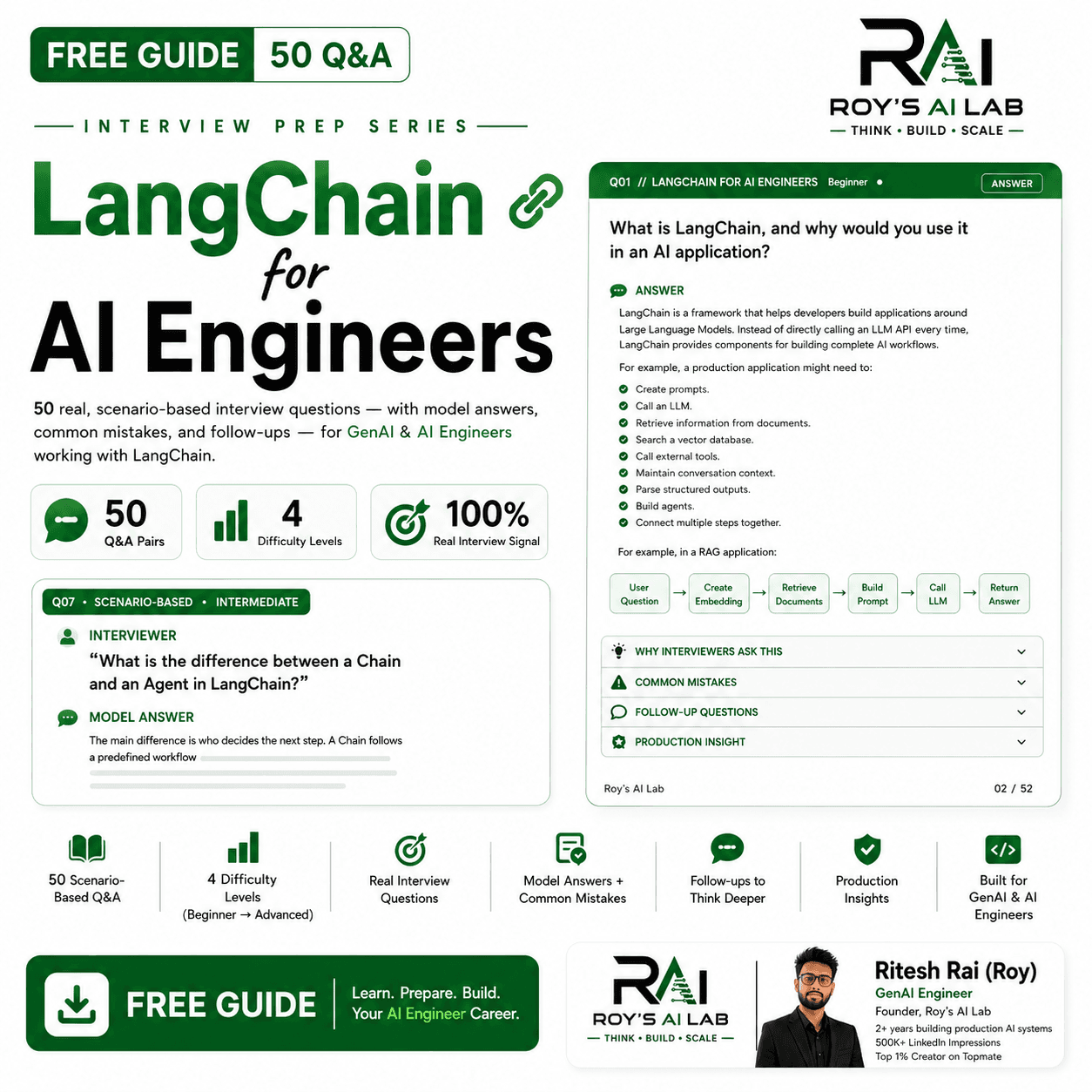
LangChain for AI Engineers: 50 Scenario-Based Production Level Interview Q&A
Master the most important LangChain interview concepts with 50 scenario-based questions, model answers, common mistakes, follow-ups, and production insights.
Preparing for AI Engineer or GenAI Engineer interviews where LangChain knowledge matters? I've compiled 50 carefully structured, scenario-based LangChain interview questions with model answers, common mistakes, follow-up questions, and production insights to help you prepare for real AI Engineering interviews. This guide goes beyond simply memorizing LangChain classes. The questions are designed to help you understand how LangChain components work together when building real AI applications, RAG systems, Agentic workflows, and production-ready GenAI applications. 📚 WHAT'S INSIDE ✅ 50 scenario-based LangChain interview Q&A ✅ 4 progressive difficulty levels ✅ Beginner → Intermediate → Senior → Principal ✅ Model answers for every question ✅ Common mistakes candidates make ✅ Likely follow-up questions ✅ Production insights throughout the guide ✅ LangChain fundamentals and core components ✅ Prompt Templates and Chat Models ✅ Chains, LCEL and Runnables ✅ RunnableSequence, RunnableParallel & RunnablePassthrough ✅ Documents and Document Loaders ✅ Text Splitting and Chunk Overlap ✅ Embeddings and Vector Stores ✅ Retrievers and Similarity Search ✅ Top-K Retrieval ✅ RAG architecture and production RAG ✅ RAG vs Fine-Tuning ✅ Conversational RAG ✅ MultiQuery Retrieval ✅ Metadata Filtering ✅ Reranking ✅ Contextual Compression ✅ Hallucination reduction ✅ RAG evaluation and production metrics ✅ Agents and Tools ✅ Tool Calling ✅ Agent decision-making ✅ Agent loop control ✅ Memory and conversation state ✅ Streaming ✅ Error handling and retries ✅ LangSmith and observability ✅ Multi-tenant RAG architecture ✅ Production deployment ✅ Security and authorization ✅ Monitoring and evaluation ✅ Cost and latency considerations 🏗️ PRODUCTION-FOCUSED PREPARATION The guide doesn't stop at basic LangChain definitions. You'll encounter practical questions around building and operating real systems, including: • How would you build a LangChain RAG application in production? • How would you reduce hallucinations? • How would you evaluate a RAG application? • How would you handle failures and retries? • How would you prevent an Agent from running forever? • How would you design a multi-tenant RAG application? • How would you deploy LangChain to production? • How would you design a production-ready LangChain application? The final production architecture question brings together authentication, authorization, retrieval, vector stores, model providers, validation, evaluation, observability, monitoring, rate limiting, error handling, streaming, CI/CD, containerized deployment, and cost monitoring. 🎯 WHAT MAKES THIS GUIDE DIFFERENT This isn't just a LangChain cheat sheet. The questions are designed around the type of reasoning expected from AI Engineers working with LangChain in real applications. You'll learn to think beyond: "What is this LangChain component?" and start thinking: "Why would I use it?" "When should I use it?" "What could go wrong?" "How would I improve the system?" "How would I make it production-ready?" "How would I explain this to an interviewer?" Every question includes additional interview context through common mistakes, follow-up questions, and production-focused insights. 👨💻 PERFECT FOR • AI Engineers • GenAI Engineers • Machine Learning Engineers • Software Engineers moving into AI • Backend Engineers building GenAI applications • Developers working with LangChain • Engineers building RAG applications • Engineers working with AI Agents • Freshers preparing for AI Engineering interviews • Anyone looking to strengthen their LangChain fundamentals 🎓 DIFFICULTY LEVELS LEVEL 1 — BEGINNER Build a strong foundation in LangChain and understand its core components. LEVEL 2 — INTERMEDIATE Understand workflows, RAG pipelines, retrieval, LCEL, Runnables, Agents, and Tools. LEVEL 3 — SENIOR Move into production concerns such as evaluation, observability, streaming, security, error handling, retrieval optimization, and Agent reliability. LEVEL 4 — PRINCIPAL Think beyond individual components and design complete, production-ready LangChain systems. 🚀 THE CORE IDEA Don't memorize 50 LangChain definitions. Learn how to think through 50 LangChain interview scenarios. By the end of this guide, you'll have a stronger understanding of how LangChain fits into real AI applications, RAG pipelines, Agentic workflows, and production AI systems. 50 questions. 4 difficulty levels. One focused LangChain interview preparation guide. And best of all... It's completely FREE.