 Roy's AI Lab
How Fortune 500 Companies Actually Use Machine Learning
4 August 2026 · Navya Sri Kurapati
About the Author
Navya Sri Kurapati is a Data Analyst and AI Educator who finds the story hidden inside the data. She's currently an AI Education Content Specialist at Early Roots AI and an Education Mentor on Topmate, where she's ranked in the top 0.1% of creators trusted by 250+ learners. As a Technology Content Strategist, she independently authors technical content on Data Science, AI, and Business Analytics — translating complex concepts into clear, actionable insights for a growing community of 30,000+ followers on LinkedIn. In this piece, she breaks down how the world's biggest companies actually put ML to work no jargon, just the business logic behind the magic.
Introduction
Machine Learning isn't just about AI research or complex algorithms. It's quietly powering many of the apps and services we use every day.
From shopping and streaming to transportation and search, here's how leading companies use ML to solve real business problems.
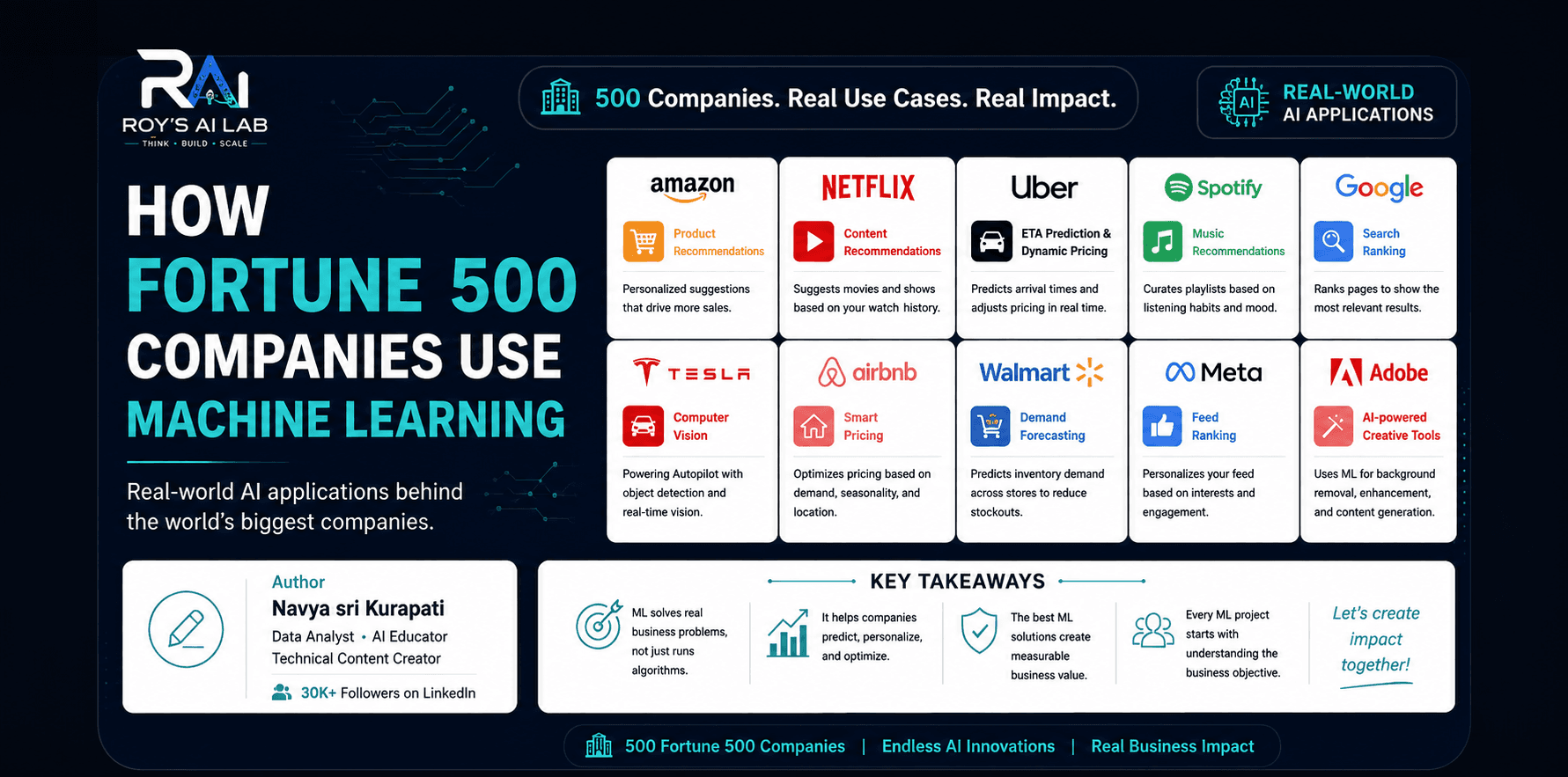
Amazon — Product Recommendations
Recommends products based on purchase history, browsing behavior, and customer preferences.
Impact: Higher sales and better customer experience.
Netflix — Content Recommendations
Suggests movies and shows based on viewing history and user preferences.
Impact: Higher engagement and lower churn.
Uber — ETA Prediction & Dynamic Pricing
Predicts arrival times and adjusts pricing using traffic, demand, and historical ride data.
Impact: Faster rides and better resource allocation.
Spotify — Music Recommendations
Creates personalized playlists by analyzing listening habits and favorite artists.
Impact: Increased user engagement.
Google — Search Ranking
Uses ML to understand search intent and rank the most relevant results.
Impact: Faster and more accurate search.
Tesla — Computer Vision
Detects lanes, vehicles, pedestrians, and traffic signs for driver-assistance features.
Impact: Improved driving safety.
Airbnb — Smart Pricing
Recommends optimal property prices using demand, seasonality, and location.
Impact: Higher occupancy and better revenue.
Walmart — Demand Forecasting
Predicts inventory demand using sales trends, weather, holidays, and promotions.
Impact: Better inventory management.
Meta — Feed Ranking
Personalizes feeds based on likes, comments, shares, and watch time.
Impact: More relevant content and higher engagement.
Adobe — AI-Powered Creative Tools
Uses ML for background removal, image enhancement, object selection, and Generative Fill.
Impact: Faster and smarter creative workflows.
Key Takeaways
-
Machine Learning is solving real business problems, not just running algorithms.
-
Every successful ML project starts with understanding the business objective.
-
The best models are the ones that create measurable business value.
Final Thoughts
Whether it's recommending your next movie, predicting product demand, ranking search results, or personalizing your social media feed, Machine Learning is transforming how businesses make decisions.
Great Machine Learning doesn't start with an algorithm. It starts with a business problem worth solving.
💬 Enjoyed this read? Share your thoughts in the comments below — We'd love to hear which of these use cases surprised you most.