 Roy's AI Lab
Do You Need Multiple AI Agents? How to Know Before You Build
A practical way to decide whether a second agent helps, and how to prove it
25 October 2026 · Ritesh Rai
Quick answer
- A second agent helps only when the task can be split into independent parts.
- Write a clear contract for each agent: its goal, sources, expected output and limits.
- Compare against a single agent or a simple workflow before you commit.
Adding a second agent feels like progress. One agent searches, another checks, a third writes the answer. More agents must mean more power, right?
Not always. Sometimes the second agent just adds more cost, more waiting and more places for things to go wrong.
This post will help you decide. By the end, you'll know when delegation is worth it, when a single agent is enough, and how to test the difference instead of guessing.
What is a multi-agent system?
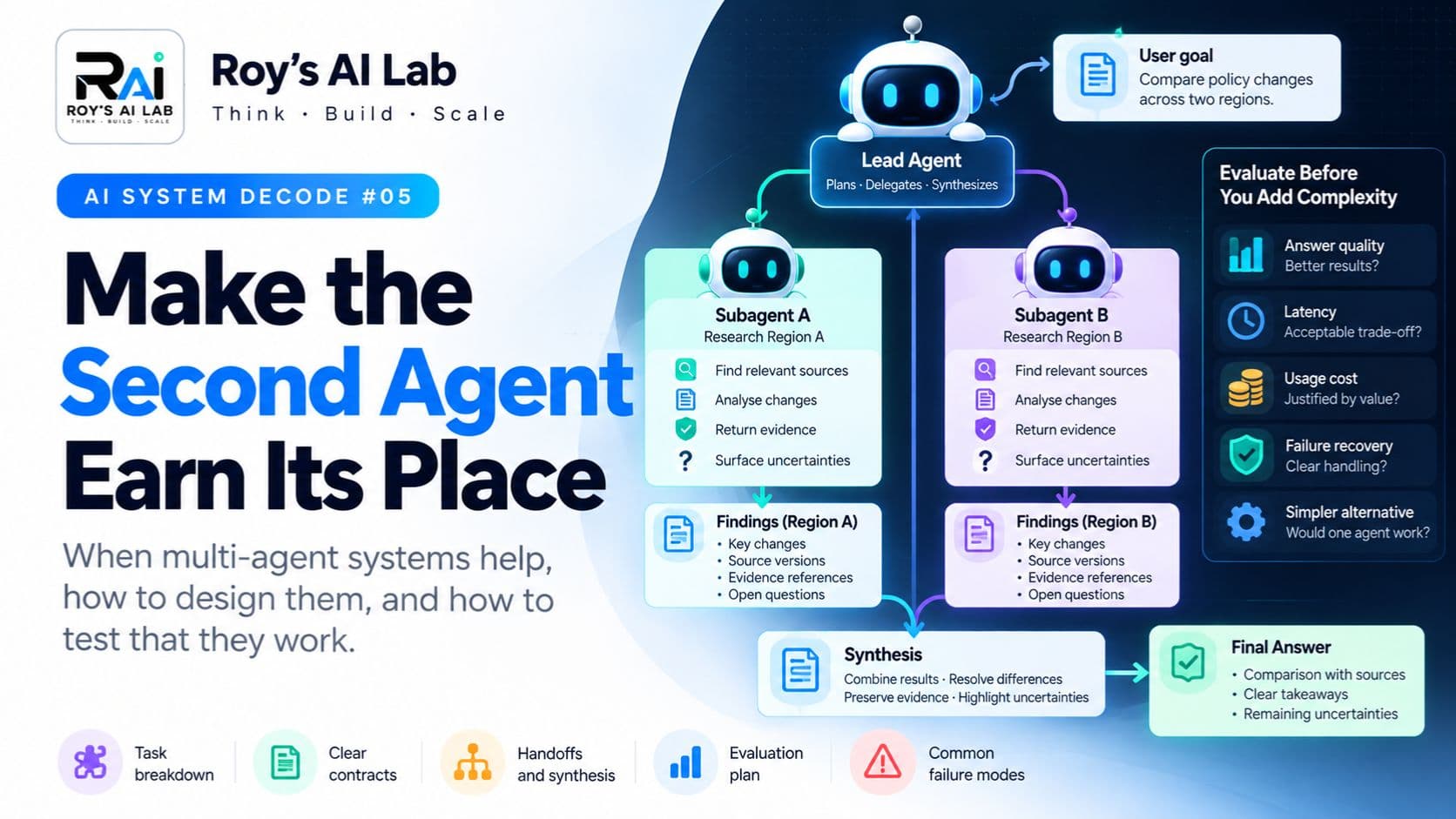
A multi-agent system splits a job between several agents. One lead agent plans the work and hands out pieces. Other agents, often called subagents, handle those pieces. Then the lead agent combines the results.
Think of it like a research team. Each person looks at a different source, then one person pulls the findings together. That can work well when the sources are separate and the work is large.
Anthropic describes a research system like this, where subagents explore different parts of a question at the same time, each with its own context window. That's one example of how it can be built. It doesn't prove that every task needs multiple agents.
Five questions to ask first
Before you build anything, answer these five questions.
Can the task be split? Independent questions are good candidates. Work where every step depends on the last one is harder to divide, because the agents keep waiting on each other.
What does each agent need? Give each agent one clear goal, the context it needs, and its limits. An agent with a fuzzy job will drift.
What must come back? Decide the output format before you start. Ask for the findings, the evidence behind them, and anything still unclear.
Who combines the results? Combining is a reasoning step, not a simple copy and paste. Someone has to check whether the findings agree, and what to do when they don't.
What's the simpler option? Compare against one agent, or a fixed workflow with clear steps. If the simpler version works just as well, you've saved time, money and complexity.
The flow, step by step
Here's the basic pattern:
              Lead agent
             /          \
    Task A (bounded)    Task B (bounded)
          ↓                  ↓
      Subagent A         Subagent B
          ↓                  ↓
   Findings, evidence and open questions
             \          /
              Synthesis
                  ↓
            Final checks
Notice the final checks at the bottom. Delegation doesn't remove the need to verify the answer.
A worked example: PolicyPal
PolicyPal is a fictional company-policy assistant. Imagine a user asks it to compare a policy change across two regions.
One possible design:
- Agent A reads the policy for Region A.
- Agent B reads the policy for Region B.
- The lead agent compares the two.
Each subagent should return:
- The version of the source it used.
- The relevant changes.
- Evidence it can point to.
- Anything missing or conflicting.
But here's the honest question: if the whole comparison fits in one short table, does delegation add much? Probably not. The extra agents would cost time and money to produce the same answer.
Write the contract first
Before you write any code, fill in a short contract for each subagent:
Objective:
Approved sources:
Task boundary:
Expected output:
Evidence required:
Uncertainty to preserve:
Stopping condition:
Escalation condition:
If you can't fill this in clearly, the problem isn't the infrastructure yet. The task needs more thought first.
This is also a good habit for anyone who designs tools. Our post on designing tool interfaces as a contract goes deeper into writing clear inputs and outputs.
Where it breaks
Here's a common failure. A subagent reports:
"Region A allows cancellation."
It leaves out the rest of the rule: "Only within 14 days for standard plans."
That summary lost a condition that changes the meaning. The lead agent now gives a confident answer that's wrong for most customers.
The fix is to ask subagents to keep the scope and the supporting evidence, not just the conclusion. A short answer with no conditions is often the most dangerous kind.
This is an illustrative example, not a measured failure rate. But it shows why you should check the details, not only the headline.
How to compare fairly
Don't decide based on a demo. Use a set of realistic tasks and compare two designs:
- A single agent, or a simple workflow.
- Your proposed multi-agent design.
For each run, look at:
- Answer quality.
- Whether each claim can be traced to evidence.
- Response time.
- Cost in usage or tokens.
- How the system recovers when something fails.
Keep the important settings the same across both designs. One impressive run tells you very little. You want to see the pattern across many tasks.
Pause and think
Two agents search the same documents and return conflicting summaries. What did delegation improve?
Pause before reading on.
The answer: very little, so far. The problem is overlapping scope and unclear rules for combining results. Fix the task boundaries and the synthesis rules first. Buying a bigger model won't solve a design problem.
A quick checklist
Before you add a second agent, ask yourself:
- Can I split this task into parts that don't depend on each other?
- Have I written a clear contract for each part?
- Do I know exactly what each agent should return?
- Do I have a plan for combining conflicting results?
- Have I compared it with a single agent on the same tasks?
If you can't say yes to all five, start with one agent and a clear workflow. You can always add agents later, once you've seen where the single agent struggles.
A note on limits
Results from one research-style system don't automatically carry over to coding, customer support or payment workflows. Those have different risks and different needs. No benchmark was run for this post, so treat it as a way to think, not a set of proven numbers.
Keep learning
Want to practise explaining agent design in an interview? Try these next:
- Free AI agent interview answers: https://roy-s-ai-lab.vercel.app/interview-qa/AI%20Agents
- The AI agent interview article: https://roy-s-ai-lab.vercel.app/blog/ai-agent-interview-questions
- Full guides and scenario packs: https://roy-s-ai-lab.vercel.app/products
Pick one of the five questions above, answer it out loud in under a minute, and then ask yourself what you'd need to test to be sure.
Sources
- Anthropic, "How we built our multi-agent research system": https://www.anthropic.com/research/multi-agent-research-system
- Anthropic, "Building effective agents": https://www.anthropic.com/engineering/building-effective-agents
The scenarios, checklist and contract template are original teaching material.
Ritesh Rai
Keep reading
Read these next
- AI AgentsStored Is Not the Same as Remembered: How AI Agents Keep TrackMemory, task state and context explained, and why your agent sometimes forgets what mattersRead
- AI AgentsBefore You Change the Prompt, Read the Agent TraceHow to debug an AI agent by following what it actually did, step by stepRead
- AI AgentsWhy Your AI Agent Should Not Obey Every Instruction It ReadsPrompt injection explained simply, and why a clear prompt is never enough on its ownRead