 Roy's AI Lab
RAG vs. Fine-Tuning: When Should You Use Each?
Two common ways to make an AI model know your information, and when to pick each
20 October 2026 · Ritesh Rai
Quick answer
- RAG brings in facts at answer time. Fine-tuning changes how the model behaves.
- Use RAG for changing or private knowledge, and fine-tuning for a consistent format or style.
- Start with the simplest option, and measure before you add anything more complex.
Should you train an AI model on your data, or should you search your data when a question comes in? It's one of the most common questions people ask when they start building AI apps, and the answers often get mixed up.
Here's the short version. RAG gives the model useful information at the moment it answers. Fine-tuning changes how the model behaves by training it on examples. Once you see that difference, the choice gets much easier.
Let's walk through it together.
First, what is RAG?
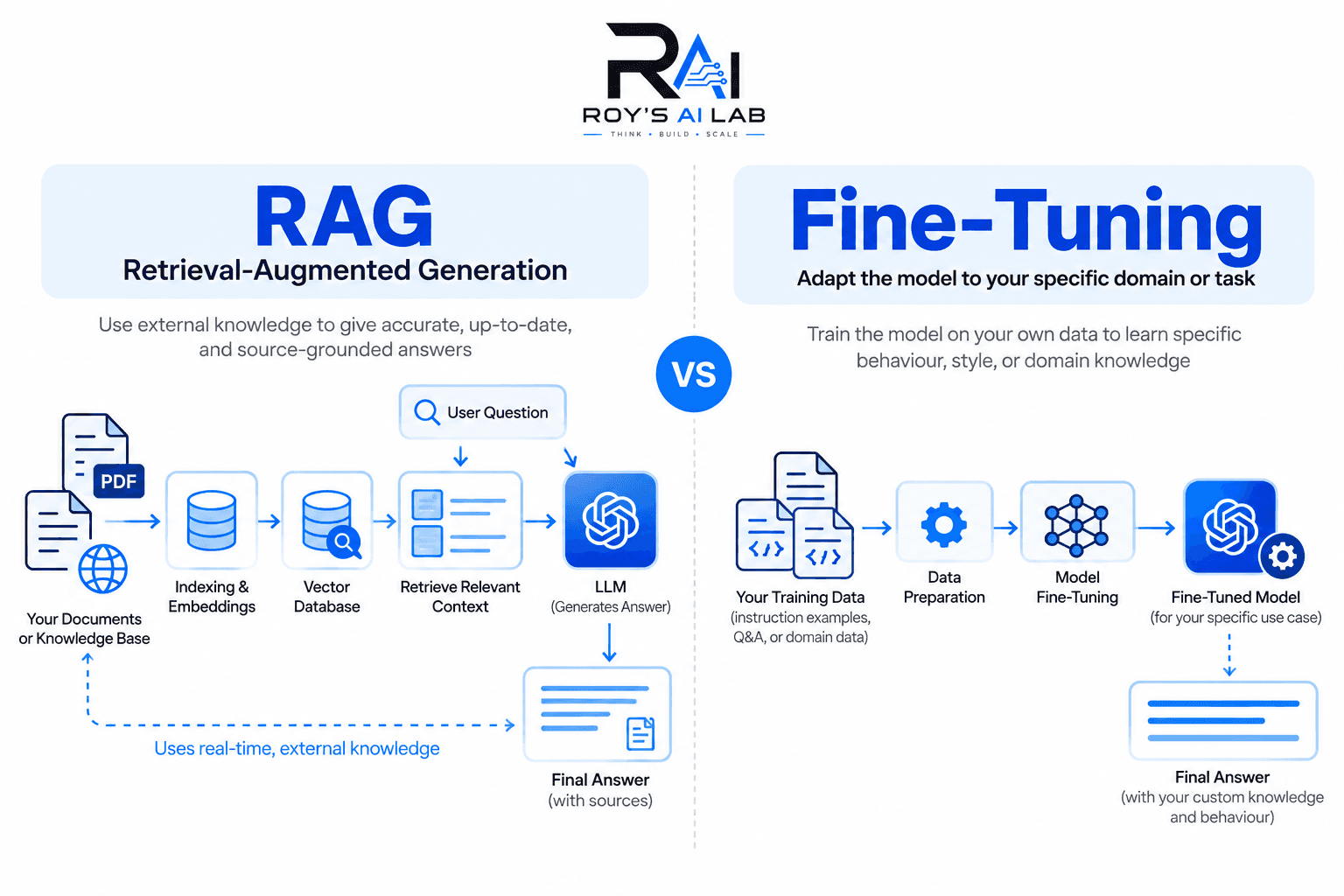
RAG searches your documents for relevant text, then gives that text to the model along with the question. The model answers using the text it was just given.
A typical flow looks like this:
- Collect your documents, web pages or records.
- Split them into smaller chunks.
- Turn the chunks into embeddings and store them in a search index.
- When someone asks a question, find the chunks that match best.
- Give the question and those chunks to the model.
- The model writes an answer based on them.
For example, an HR assistant gets a question about leave. It finds the latest leave policy and answers from it. When the policy changes, you update the document, not the model.
If you want to see how retrieval works in more detail, read our RAG explained guide.
Then, what is fine-tuning?
Fine-tuning means training a pretrained model a bit more, using examples you've chosen. The goal is to teach it a pattern, such as a certain format, tone or task.
It can help when you need:
- A consistent output format.
- Domain-specific wording or style.
- A repeated task done the same way every time.
- Classification or structured extraction.
But fine-tuning doesn't give the model reliable access to fresh facts. Training data gets old, and the model can still get things wrong.
The practical differences
| Question | RAG | Fine-tuning |
|---|---|---|
| Do you need current or frequently updated facts? | A strong fit | Usually not the main solution |
| Do answers need to come from private documents? | A strong fit | Doesn't look up documents by itself |
| Do you need a consistent style or format? | Can help through context and instructions | Can help with good training examples |
| Do you need citations to sources? | Can return the source it used | Doesn't provide citations by itself |
| How do you update knowledge? | Update the source and the index | Often needs another training run |
| What's the main day-to-day work? | Ingestion, search, evaluation, permissions | Dataset preparation, training, evaluation, versioning |
When to pick RAG
Pick RAG when the answer depends on information that changes, is private, or needs a source you can point to. Some common examples:
- Product documentation assistants.
- Policy and procedure search.
- Customer support knowledge bases.
- Research assistants that show citations.
Keep in mind that RAG is only as good as its sources, chunking, search and reranking. A vector database alone won't fix weak answers.
When to fine-tune
Pick fine-tuning when you have a clear behaviour problem and enough good examples to train and test with. Some examples:
- A specific structured response format.
- Sorting a recurring set of requests into categories.
- A writing style that prompting alone can't hold.
Before you start, set a baseline. Write a good prompt, build a test set, and measure the results. Without a baseline, you can't tell whether fine-tuning actually helped.
Can you use both?
Yes. You might fine-tune a model so it answers in your brand's tone, then use RAG to bring in the latest product details. It's a good setup, but it adds complexity. Only add a part when your tests show it solves a real problem.
A simple way to decide
Ask these questions in order:
- Is the problem missing or changing knowledge? Try RAG first.
- Is the problem the format or behaviour of the answers? Improve the prompt first, then consider fine-tuning.
- Do answers need to cite current sources? Build retrieval with citation checks.
- Can you measure success? Build a test set before choosing a method.
- Is the extra complexity worth it? Compare against a simpler version.
If you're unsure how to measure results, our RAG evaluation guide gives you a clear way to start.
Conclusion
RAG gives a model information at the moment it answers. Fine-tuning changes how the model behaves. Neither one solves everything, and both need proper testing.
Start with the simplest option that fixes the problem you've measured. If answers use the wrong context, work on retrieval. If the model misuses good context, work on the prompt. If the style stays inconsistent, then consider fine-tuning.
Ready to practise? Try the free RAG practice sets, and read the free RAG interview answers.
Keep reading
Read these next
- RAG SystemsBM25 vs Vector Search vs Hybrid Search: A Practical Retrieval GuideStop guessing which search to use. Compare, combine and test themRead
- RAG SystemsHow to Debug a RAG System That Retrieves the Wrong Context?A step-by-step way to find out why your RAG answers are offRead
- RAG SystemsHow Do You Evaluate a RAG System? The 4 Metrics That Actually MatterThe four numbers that tell you whether your RAG system is really workingRead