 Roy's AI Lab
RAG Explained: Why Your LLM Doesn't Actually Know Anything (And How to Fix That)
31 July 2026 · Ritesh Rai
The problem RAG solves
Ask an LLM about something that happened after its training cutoff, or something private — your company's internal docs, your product's pricing, last week's support tickets — and it will either say "I don't know" or, worse, confidently make something up.
This isn't a bug. It's a fundamental limitation. The model's knowledge is frozen at training time, and it has no access to your data.
Retraining the model every time your data changes isn't realistic. It's slow, expensive, and impractical for data that updates daily.
RAG — Retrieval-Augmented Generation — solves this without touching the model's weights at all.
The core idea
Instead of asking the LLM to remember everything, you give it the relevant information at the moment it needs it.
User Question
      │
      ▼
Retrieve relevant documents
      │
      ▼
Stuff them into the prompt
      │
      ▼
LLM generates an answer using that context
The model isn't recalling facts from training — it's reading documents you handed it, the same way you'd hand a colleague a reference doc before asking them a question.
How retrieval actually works
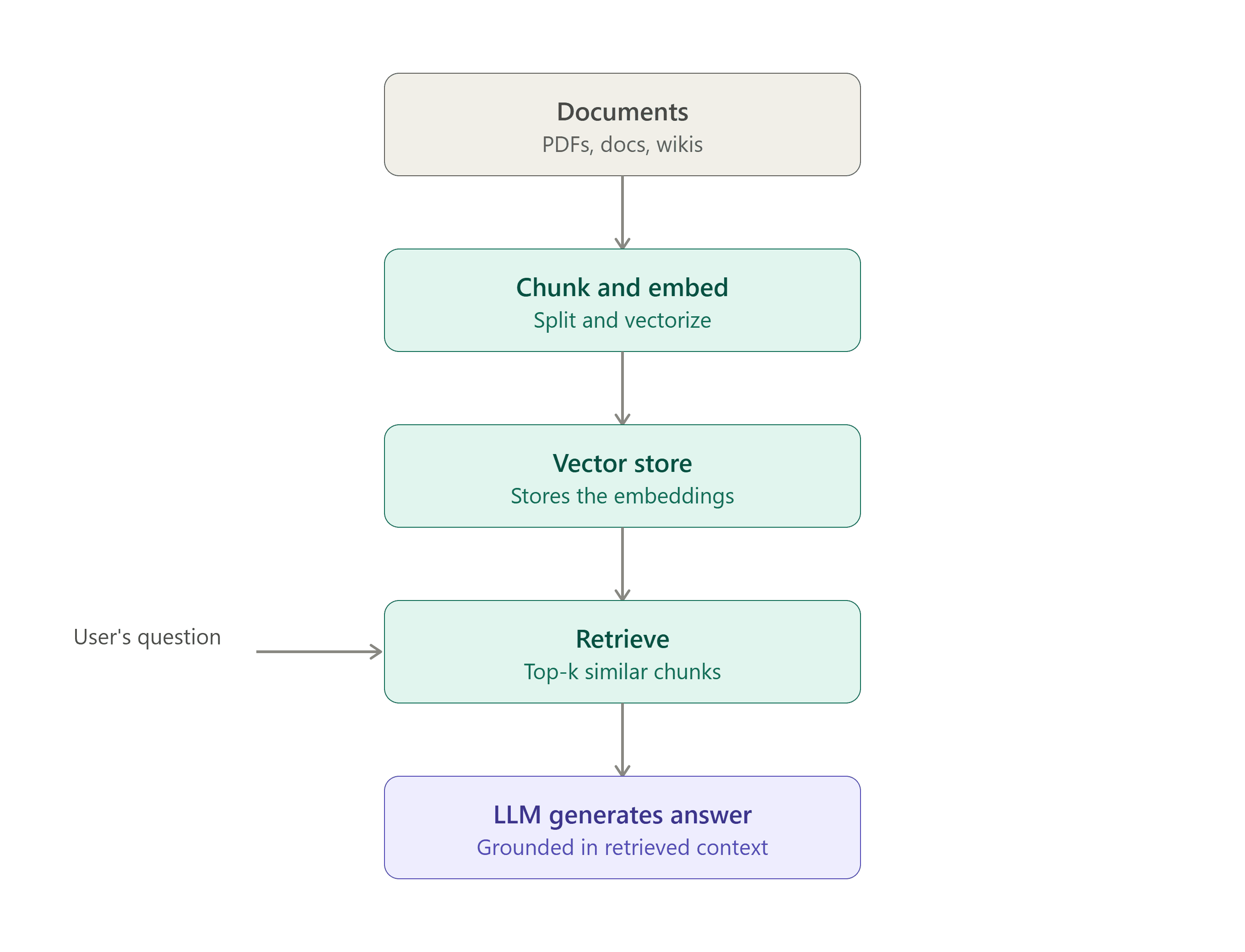
Step 1 — Chunking
Your documents (PDFs, wikis, support tickets, whatever) get split into smaller chunks — usually a few hundred words each. You can't hand an LLM your entire 200-page policy manual on every question; you need just the relevant paragraph.
Step 2 — Embedding
Each chunk gets converted into a vector — a list of numbers that captures its meaning, not just its words. Chunks about similar topics end up mathematically close to each other in vector space, even if they don't share any exact words.
Step 3 — Storing
Those vectors get stored in a vector database (FAISS, Pinecone, OpenSearch, pgvector — take your pick), built specifically for fast similarity search across millions of vectors.
Step 4 — Retrieval
When a user asks a question, that question also gets embedded into a vector. The system finds the chunks whose vectors are closest to the question's vector — meaning: most semantically similar.
Step 5 — Generation
The retrieved chunks get inserted into the prompt alongside the user's question, and the LLM generates an answer grounded in that specific context — not from memory.
Here's the whole pipeline in one picture:
User's question
Why this matters
- No retraining needed — update your documents, and the system immediately has the new information.
- Reduces hallucination — the model is answering based on real, retrieved text, not guessing.
- Citeable answers — you can show users exactly which document backed up the answer.
- Works with private data — your internal docs never need to touch a training pipeline.
Where it breaks down
RAG isn't magic. Common failure points:
- Bad chunking — split documents wrong, and you either lose context or bury the relevant info.
- Weak retrieval — if the wrong chunks get retrieved, the LLM will confidently answer using irrelevant context.
- No re-ranking — the first-pass retriever isn't always precise; a re-ranker often meaningfully improves what actually makes it into the prompt.
- Ignoring evaluation — teams that don't measure faithfulness and retrieval quality often don't notice quality dropping until users complain.
The takeaway
RAG isn't a hack — it's the standard architecture for building LLM applications that need to be accurate, current, and grounded in real data. If you're building anything beyond a toy chatbot, understanding RAG isn't optional anymore.
— Ritesh Rai