 Roy's AI Lab
Hybrid Search: Two Paths, One Ranking (and Why the Merge Needs Testing)
Why keyword and semantic search work better together, and why you still have to test the combination
31 October 2026 · Ritesh Rai
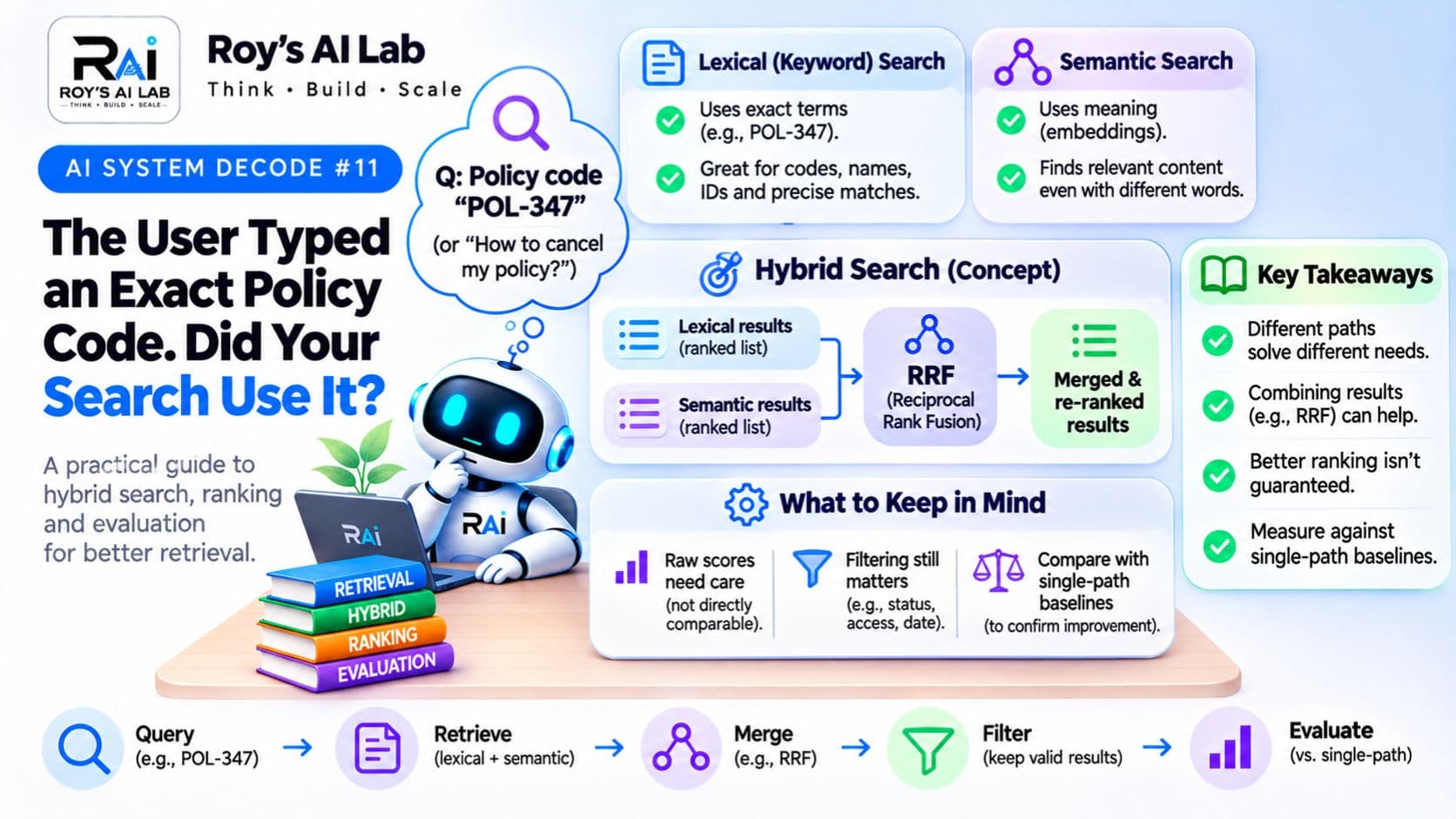
Quick answer
- Hybrid search runs keyword retrieval and semantic retrieval side by side, then merges them into one ranked list.
- Merging results (fusion) and rescoring candidates (reranking) are different steps. A system can use both.
- A high rank after merging doesn't make a document allowed to be used. Access and version rules still need enforcing before generation.
Your search system has a blind spot. Ask it for a policy identifier, and it finds the exact match. Ask it a question in everyday words, and it finds related ideas but misses the exact policy.
Neither method fails everywhere. Keyword search misses paraphrases. Semantic search can drift past exact identifiers. Hybrid search tries to cover both blind spots by running the two methods side by side.
But "run both" isn't the end of the story. You still have to decide how to merge the two lists, and whether the merged list is better than either method alone.
Why read this? Because hybrid search is now a default recommendation in many RAG systems, and "we added hybrid search" is only a useful claim if you can show it helped.
Two paths, one list
Here's the shape of a hybrid system:
                    Query
                   /     \
        Lexical retrieval  Semantic retrieval
                   \     /
                 Result fusion
                       ↓
              Unified candidates
                       ↓
          Optional reranking or selection
                       ↓
                  Generation
The two paths do different jobs. Lexical retrieval matches terms. Semantic retrieval matches meaning. Fusion combines their result lists into one ranking. Reranking then rescores a shortlist with a more careful model, if you choose to add that step.
Fusion and reranking are not the same
People often use these words interchangeably. They shouldn't.
Fusion combines result lists. It takes what the retrievers found and merges it into one ordering.
Reranking applies another scoring stage to a set of candidates, usually with a more powerful and more expensive model.
A system can use fusion alone, reranking alone, or both. Knowing which step you're talking about matters when you explain your design or debug a bad result.
Five things to understand
Lexical retrieval works with terms. Methods such as BM25 rank documents using term-based signals. That's useful for distinctive names, identifiers and specialised vocabulary. It doesn't guarantee that every exact-string query will succeed, because the wording in the document still has to match.
Semantic retrieval works with learned representations. It can find related material even when the wording differs. How well it works depends on the model, the corpus and the query.
Raw scores often aren't comparable. A keyword score and a vector similarity score can sit on different scales. Adding them directly, without a reasoned method for combining them, can quietly let one signal dominate.
Reciprocal Rank Fusion uses rank positions. One common merging method, reciprocal rank fusion (RRF), combines lists using each document's position in each list, rather than comparing raw scores. Elastic's documentation recommends RRF as its default method for combining full-text and vector results.
More retrieval still needs boundaries. Access restrictions, version rules and eligibility conditions still have to be enforced. Fusion decides what ranks highly. It doesn't decide what a user is allowed to see.
A worked example
Consider two queries your team might receive:
Query A: "What changed in policy HR-104?"
Query B: "What happens if I need time away to care for a relative?"
Query A contains a distinctive identifier. Keyword matching is likely to help a lot here.
Query B expresses an intent. The policy might use different words, such as "carer's leave" or "dependant care." Semantic matching is likely to help more.
Before reading on, which method would you expect to work best for each query? Then ask yourself: would you assume a hybrid system handles both?
The answer: the intuition suggests each query favours a different method, and hybrid search is designed to cover both. But that's a hypothesis, not a result. You need test queries of both kinds, measured on your own corpus, before you claim the hybrid system works.
Evaluate the combination
Compare three setups on the same corpus and the same labelled queries:
- Keyword-only retrieval.
- Semantic-only retrieval.
- Hybrid retrieval.
Then inspect more than a single average. Check:
- Whether the relevant evidence is retrieved at all.
- Where it ranks in the list.
- How performance differs between query types, such as identifier lookups and natural-language questions.
- Latency and operating cost.
- The quality of the final answer, not only the retrieval numbers.
An overall average can hide a weakness that matters a lot. A hybrid system might look better on average while quietly failing the identifier queries your compliance team depends on.
Pause and think
Your hybrid result list includes an old policy that the user isn't allowed to access. It ranks second, which is high.
Does that high fusion rank make the policy eligible to be used in the answer?
Pause before reading on.
The answer: no. Relevance ranking doesn't replace eligibility checks. Access rules and version rules have to be enforced before a passage can reach the model. A search system that ranks a document highly isn't granting permission to use it. This matters more in hybrid search, because a broader candidate set means more documents need checking.
Why reranking needs careful thinking
Elastic's documentation makes a useful distinction when it comes to reranking. Cross-encoder rerankers read the query and a document together, and their scores tend to stay consistent across queries. Bi-encoder similarity scores depend on the query, which means you can't set one universal cut-off that works for every question.
That matters if you plan to use a minimum score to keep weak candidates out of a RAG prompt. The right threshold depends on the model you use, and it should be tested on your own queries, not borrowed from a tutorial.
An interview follow-up
"Why not just add the keyword score and the vector score together?"
A clear answer: "The two scores usually sit on different scales, so adding them can let one signal dominate for numerical reasons, not because it's more relevant. Rank-based fusion like RRF avoids that problem by using each document's position in each list. I'd still evaluate the merged results against keyword-only and semantic-only baselines, and check performance by query type, before I claim the combination is better."
A quick checklist
Before you add hybrid search to a RAG system, ask yourself:
- Have I compared hybrid retrieval with keyword-only and semantic-only baselines on the same queries?
- Do my test queries include identifiers, natural-language questions and paraphrases?
- Am I checking results by query type, not only in one average?
- Do I know whether I'm talking about fusion, reranking or both?
- Are access and version rules enforced before a passage reaches the model?
A note on limits
This post doesn't prescribe a single fusion method or configuration. The examples are fictional, and no search benchmark was run. The right design depends on your corpus, your users and what a wrong answer costs.
Keep learning
Want to connect this to the rest of your retrieval thinking?
- BM25 vs vector search vs hybrid search: https://roy-s-ai-lab.vercel.app/blog/bm25-vs-vector-search-vs-hybrid-search
- Similar is not the same as supported: https://roy-s-ai-lab.vercel.app/blog/similarity-is-not-supporting-evidence
- RAG explained, in plain English: https://roy-s-ai-lab.vercel.app/blog/rag-explained-why-your-llm-doesn-t-actually-know-anything-and-how-to-fix-that
- Free RAG practice sets: https://roy-s-ai-lab.vercel.app/topics/rag
- Full guides and scenario packs: https://roy-s-ai-lab.vercel.app/products
Try this: write two test queries for one of your own documents. One should use the exact identifier in the text, and the other should use everyday words for the same idea. Run both through each retrieval method and see what comes back.
Sources
- Elastic, "Hybrid search": https://www.elastic.co/docs/solutions/search/hybrid-search
- Elastic, "Ranking and reranking": https://www.elastic.co/docs/solutions/search/ranking
The first source confirms that Elastic recommends RRF for combining full-text and vector results. The second was checked for its explanation of reranking and of why bi-encoder similarity scores depend on the query. The draft's "what is hybrid search" address could not be confirmed and has been replaced with the docs page above. The examples, checklist and worked comparison are original teaching material.
Ritesh Rai
Keep reading
Read these next
- RAG SystemsSimilar Is Not the Same as Supported: Why Search Results Need CheckingWhy the closest match in your RAG system is not always the right answerRead
- RAG SystemsBM25 vs Vector Search vs Hybrid Search: A Practical Retrieval GuideStop guessing which search to use. Compare, combine and test themRead
- RAG SystemsHow to Debug a RAG System That Retrieves the Wrong Context?A step-by-step way to find out why your RAG answers are offRead